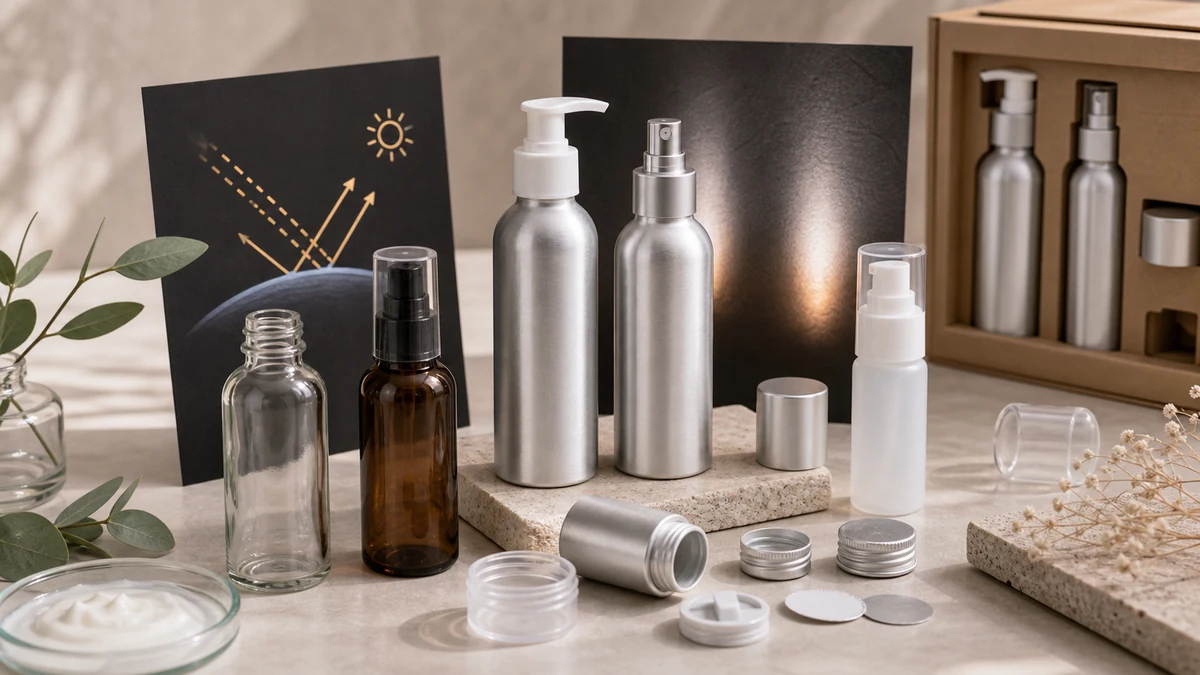
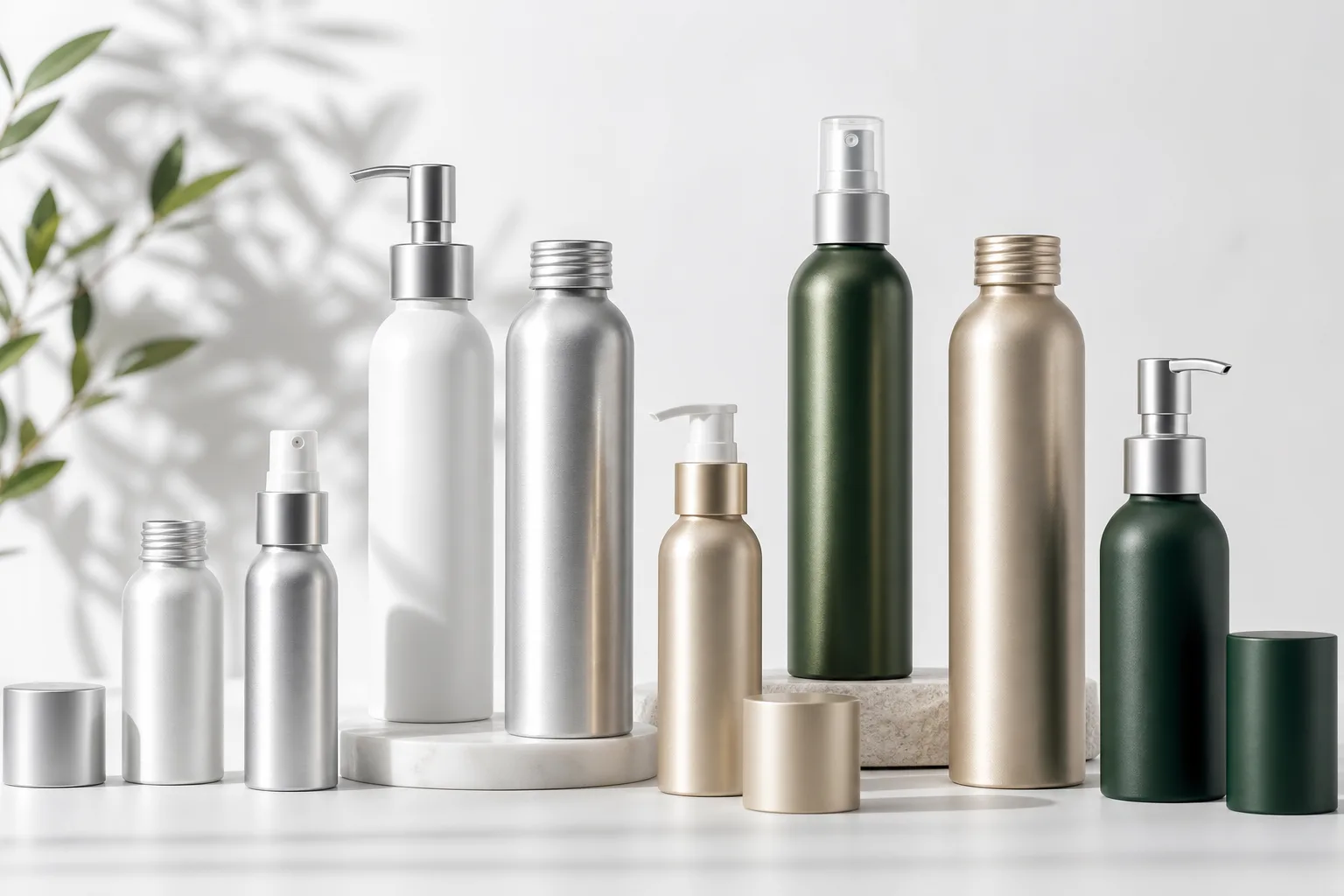
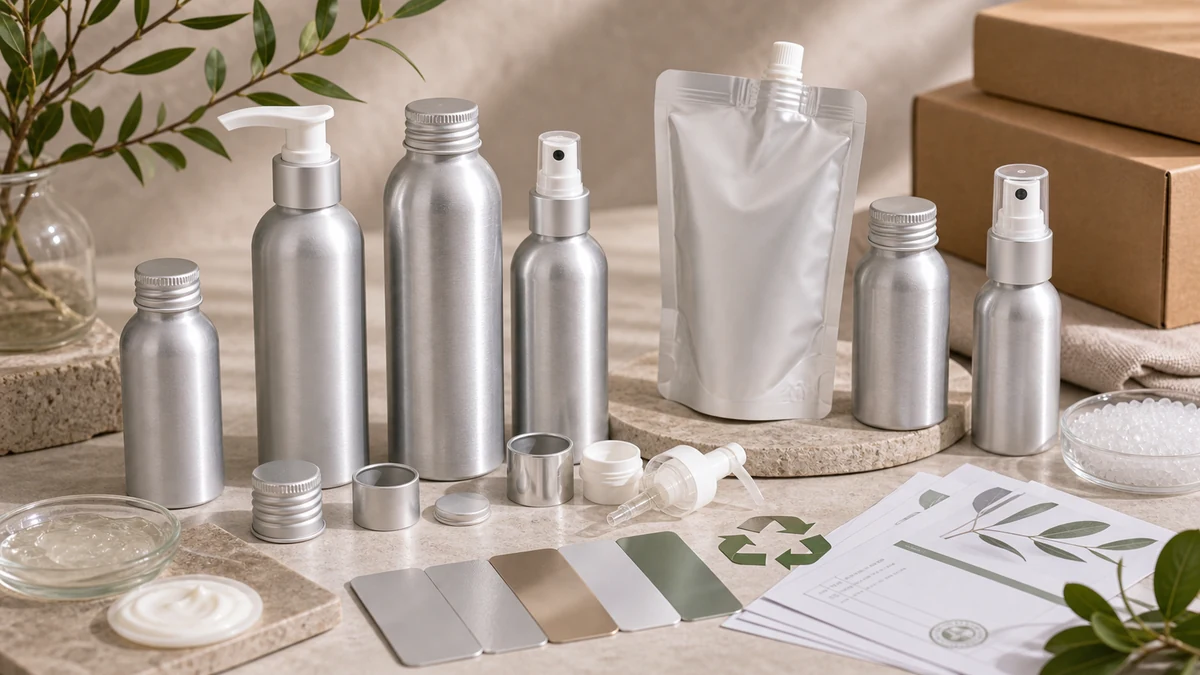
Aluminum packaging can give a cosmetic line a premium metal look, lighter handling than glass, and a stronger material story than a plain plastic pack. The catch is simple: a good-looking aluminum sample does not prove formula compatibility, pump performance, decoration durability, or recyclable-claim support. Brand teams should choose aluminum by format first, then review the liner or coating, closure, decoration, filled sample, carton, and claim wording together.
This guide explains how beauty brands can compare aluminum bottles, jars, tubes, and tins before requesting samples or quotes.
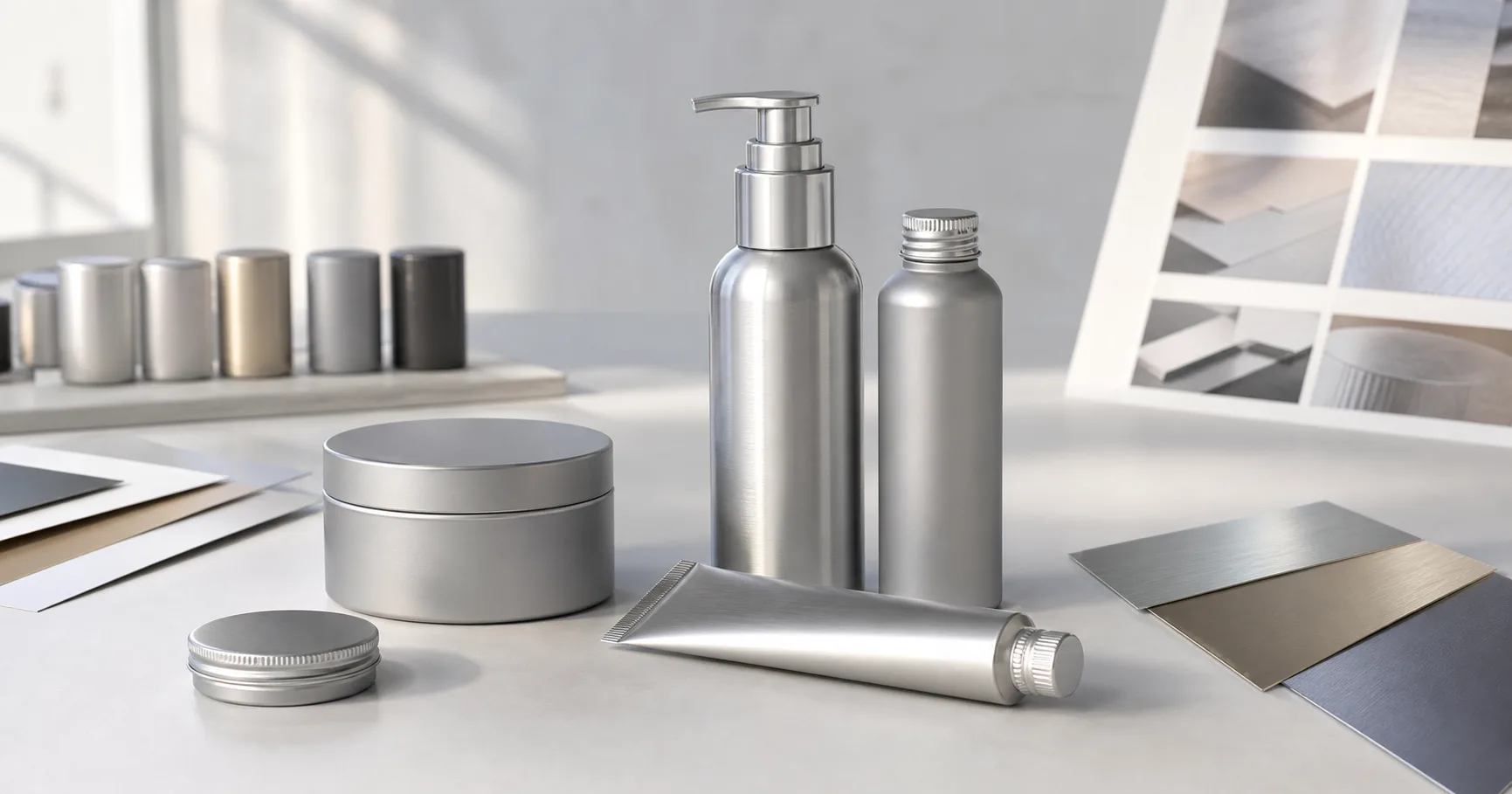
Aluminum packaging should be reviewed as a complete package system, not only as a metal shell.
Quick answer: when aluminum packaging makes sense
Use aluminum when the product needs a metal finish, strong shelf presence, light-blocking body, collapsible tube, balm tin, or refill-adjacent component set. Slow down when the formula is acidic, fragrance-heavy, oil-rich, or needs a pump, sprayer, crimp, liner, or recyclability claim that has not been checked on the final pack.
| Decision | Good signal | Check before moving forward |
| Choose aluminum | The brand wants a premium metal look, opaque body, tube format, tin format, or lighter alternative to glass. | Confirm the actual product-contact surface and closure route. |
| Compare with plastic or glass | The brand needs transparency, squeezability, lower dent risk, or a simpler recycling claim path. | Compare the full component set, not only the outside material. |
| Request samples | The package format is clear and the formula, closure, finish, and claim goals are known. | Ask for dry samples, decorated proofs, filled samples, and packout checks. |
| Delay the claim | The team wants to say recyclable, recycled-content, refillable, plastic-free, or lower carbon. | Confirm supplier documentation and claim review before printing or publishing the wording. |
Scope and source note
This article uses research checked on May 16, 2026. It is written for cosmetic, skincare, makeup, body care, hair care, and personal care packaging teams. It does not cover food cans, beverage cans, paint cans, industrial metal containers, sports bottles, or broad metal manufacturing.
Aluminum as a material has strong recycling value, but package-level claims still need care. The Aluminum Association describes aluminum recycling at the material level. The EPA aluminum material-specific data shows that not all aluminum packaging in U.S. municipal waste is recycled. The FTC Green Guides in 16 CFR Part 260 require environmental claims to be supported and not overstated. Programs such as How2Recycle can help review package-specific recyclability labeling.
Use those sources as claim guardrails, not as proof that a specific aluminum cosmetic package is recyclable, sustainable, refillable, or made with recycled content.
What aluminum packaging means in cosmetics
In cosmetic packaging, "aluminum packaging" can mean several different things. A bottle may have an aluminum body with a plastic pump. A tube may need an internal coating and crimp. A jar may rely on a liner, seal, insert, or coated interior. A lipstick or stick component may use aluminum only as the outer shell. That difference matters when a team writes a spec or a claim.
| Format | Common cosmetic use | What to define |
| Aluminum bottle | Lotion, toner, mist, body care, hair care, refill-adjacent formats | Fill volume, formula type, inner coating or liner, neck finish, pump or sprayer, cap, decoration, carton protection |
| Aluminum jar | Balm, cream, mask, wax, solid perfume, body butter, sample sets | Jar body, lid, liner or seal, insert, interior finish, decoration, filled weight |
| Aluminum tube | Hand cream, treatment cream, balm, hair care, specialty formulas | Tube body, internal coating, crimp, cap, orifice, viscosity, oozing risk, user handling |
| Tin or metal container | Lip balm, salve, solid fragrance, powders, gift sets, sample kits | Metal type, coating or liner, hinge or screw lid, formula contact, decoration, carton or sleeve |
| Aluminum component | Cap, collar, over-shell, actuator, outer shell, decorative part | Whether the claim describes the whole package or only one component |
For product browsing, use the JPS Packaging aluminum cosmetic packaging range. For specific formats, compare aluminum bottles, aluminum jars, and aluminum tubes.
Choose the format before choosing the finish
A good aluminum package starts with the formula and use case. The finish comes later. A brushed silver surface may look right in a sample photo, but it does not answer whether the pump output works, whether the liner fits the formula, whether the tube crimps cleanly, or whether the carton prevents dents in transit.
| Product situation | Format worth reviewing | Main checks before sampling |
| Facial mist, toner, lightweight body care | Aluminum bottle with sprayer or pump | Inner coating, neck finish, actuator output, dip tube length, cap fit, leakage, packed-sample scuffing |
| Lotion or emulsion | Aluminum bottle with lotion pump | Viscosity, pump output, gasket/liner, formula contact, pump priming, carton protection |
| Balm, wax, solid perfume, cream, mask | Aluminum jar or tin | Interior coating, lid fit, liner or seal, finger access, hygiene expectations, filled weight |
| Hand cream, treatment cream, hair care | Aluminum tube | Internal coating, pH/product characteristics, crimp, cap, orifice, oozing behavior, denting |
| Premium set or refill-adjacent line | Mixed aluminum, glass, plastic, paperboard, or refill parts | Which component carries the claim, how the refill route works, and whether each part can be labeled accurately |
If the article question is mostly about product availability, stay on the format page. If the question is about how to brief the package, keep reading and build the RFQ around the full package system.
If you are already comparing aluminum bottles, jars, or tubes for a launch, send JPS your formula type, fill volume, preferred closure, finish direction, sample deadline, and any recycling or refill claim you want reviewed. That is enough for a first packaging-fit discussion before you lock artwork.
Bottles: review the whole dispensing system
An aluminum bottle is more than a metal body. For cosmetic and personal care products, the bottle needs a compatible product-contact surface, a closure that matches the formula, and a decoration route that can survive filling, packing, and handling.
For a bottle project, confirm these details before approving artwork:
Bottle capacity and fill weight.
Neck finish and closure match.
Pump, sprayer, screw cap, or disc cap route.
Dip tube length and output per stroke when a pump or sprayer is used.
Inner coating or liner information.
Formula notes, including viscosity, fragrance, oils, alcohol, acids, or active-heavy ingredients.
Decoration method and sample proof.
Packed-sample plan for scuffing, denting, and leakage.
For skincare-specific bottle decisions, use this guide with the deeper JPS article on aluminum bottle for skincare.
Jars and tins: check the product-contact surface
Aluminum jars and tins can be useful for balms, waxes, solid perfume, creams, masks, sample sets, and specialty beauty products. They give a lightweight metal feel and a different shelf signal from glass or plastic. The common mistake is treating the outside material as the whole specification.
The inside surface matters most. Before ordering, confirm whether the product touches bare metal, a coating, a liner, an insert, or a seal. For water-based creams, acidic formulas, fragrance-heavy balms, or oil-rich products, do not assume compatibility from appearance. Ask for supplier documentation and test the filled sample.
| Package check | Why it matters |
| Interior coating or liner | Determines the actual product-contact surface. |
| Lid fit and torque | Affects leakage, evaporation, user feel, and shelf handling. |
| Seal or insert | Helps with hygiene, shipping, and first-use experience. |
| Decoration route | Printed, labeled, embossed, lacquered, or brushed surfaces behave differently. |
| Carton or sleeve | Helps protect the finish and provides space for required copy. |
For format selection, compare JPS aluminum jars after the formula and fill-weight requirements are clear.
Tubes: plan for crimp, coating, and user handling
Aluminum tubes can be a good fit for creams, balms, hair care, and specialty formulas that need a collapsible metal tube format. They also create practical questions that do not always appear on product listing pages.
The research pack found real customer-like concerns around metal tubes: oozing, splitting, leakage, dents, and residue. Those comments are anecdotal, but they point to practical package checks: viscosity, fill level, crimp quality, cap fit, orifice size, coating, and how the tube behaves after repeated squeezing.
For an aluminum tube brief, include:
Formula type and viscosity.
Fill weight and headspace expectation.
Internal coating or liner requirement.
Cap type and orifice size.
Crimp or seal expectation.
Decoration route and artwork placement.
Carton, tray, or divider needs.
Filled-sample checks before bulk approval.
For a format-specific discussion, review JPS aluminum tubes.
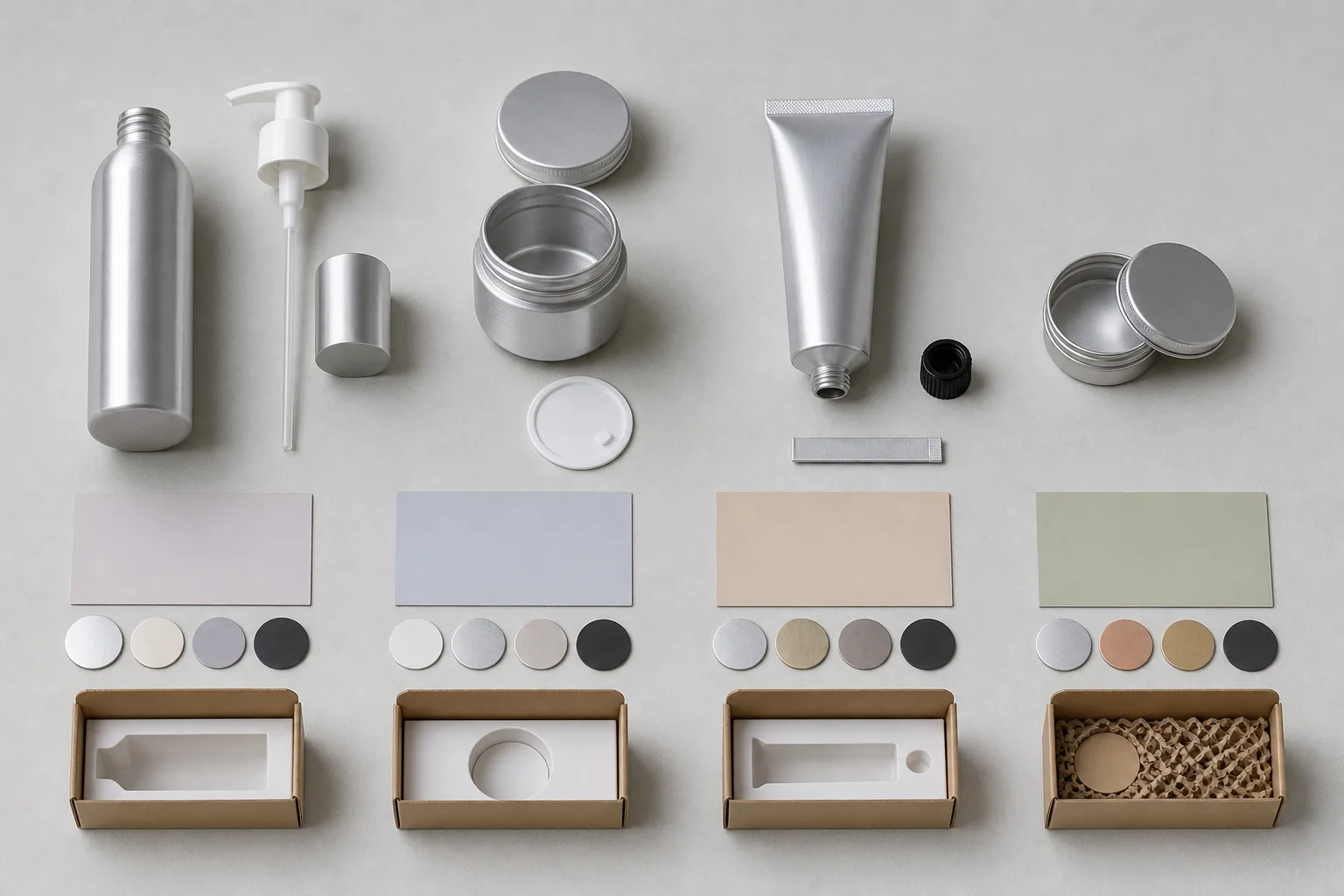
Use sample review to connect the metal body with the closure, liner, decoration, and packout.
Liners and coatings are not optional details
The first aluminum packaging question is blunt: "What actually touches the formula?"
Depending on the format, product contact may involve an internal coating, liner, seal disc, gasket, pump part, dropper part, cap liner, tube coating, adhesive, or label material. A package that works for one product may not fit another product with different pH, fragrance, oil level, solvent, preservative system, viscosity, or storage conditions.
Do not approve aluminum packaging from dry samples alone. A dry sample can confirm shape, finish, hand feel, and decoration direction. It cannot prove formula compatibility. Before bulk approval, review filled samples and keep notes on leakage, color change, swelling, odor, corrosion, oozing, pump performance, cap fit, and visible finish wear.
Decoration and finish options
Aluminum packaging is often selected for its finish. Brushed metal, matte color, satin silver, champagne, anodized-look effects, lacquered surfaces, labels, screen printing, hot stamping, embossing, and cartons can all change how the package is perceived.
| Finish or decoration route | Useful when | What to test |
| Brushed or satin metal | The brand wants a clean metal signal without heavy color coverage. | Directional brushing, fingerprint visibility, scuffs, carton marks. |
| Matte or gloss coated color | The line needs a custom brand color or softer shelf look. | Color tolerance, rub resistance, coating adhesion, claim impact. |
| Direct printing | Logo or simple copy should appear on the component. | Registration, ink adhesion, curved-surface behavior, abrasion. |
| Label | More copy, multi-language content, or shorter run flexibility is needed. | Label stock, adhesive, oil/moisture exposure, label edge lift. |
| Hot stamping or metallic detail | The design needs a highlight or premium accent. | Foil placement, wear, pressure marks, surface compatibility. |
| Carton or sleeve | The primary pack has limited label space or needs protection. | Carton fit, insert, rub points, required copy, retail handling. |
For print and artwork decisions, use the JPS guide to packaging decoration and labeling. For custom finish review, prepare the package format, artwork, target color, sample deadline, and expected order route before asking for a quote through custom cosmetic packaging options.
Recyclability and sustainability claims need package-level review
Aluminum is widely valued because it can be recycled as a material. That does not make every aluminum cosmetic package automatically recyclable in every market. Brand teams still need to review the full package: metal body, cap, pump, sprayer, liner, label, adhesive, coating, small size, decoration, residue, local collection, sorting, and end-market access.
The FTC Green Guides are useful because they push marketers away from broad, unsupported environmental claims. For packaging teams, the practical rule is simple: write the claim only as strongly as the final package evidence allows.
| Claim idea | Safer claim check |
| "Recyclable aluminum packaging" | Confirm whether the exact component set can make an unqualified, qualified, or no recyclable claim in the target market. |
| "Made with recycled content" | Confirm supplier documentation, component scope, percentage, and whether the claim refers to the package, a part, or the material. |
| "Refillable" | Confirm the refill system, refill product, durable package plan, and consumer instructions. |
| "Sustainable" or "eco-friendly" | Avoid broad wording unless the claim is specific, supported, and reviewed. |
| "Lower carbon footprint" | Do not use without credible life-cycle or supplier evidence for the actual package route. |
For broader material tradeoffs, compare sustainable packaging materials and JPS sustainable cosmetic packaging options.
MOQ, lead time, and sample planning
MOQ and timing depend on the format, stock availability, finish route, tooling, decoration, component set, carton, and supplier schedule. Treat early numbers as planning inputs, not promises. A stock aluminum bottle with a standard closure follows a different path from a custom color jar, a special tube coating, or a refillable set with several matched components.
Before asking for pricing, prepare:
Package format: bottle, jar, tube, tin, or mixed component set.
Fill volume and product type.
Formula notes and compatibility concerns.
Closure or dispensing route.
Inner coating, liner, seal, or insert requirement.
Decoration method and artwork status.
Sustainability or recycling claim the brand wants to make.
Sample deadline, launch date, destination market, and target order quantity.
Ask the supplier to separate stock-component options from custom finish, custom tooling, and claim-documentation needs. This makes quotes easier to compare.
When aluminum is not the best route
Aluminum is not always the right packaging choice. Consider another format when:
The formula needs a product-contact surface the supplier cannot document.
The claim depends on recycling access that cannot be supported in the target market.
The brand needs a clear container to show color or fill level.
Denting or finish wear would be unacceptable for the sales channel.
The pump, sprayer, cap, crimp, or seal cannot pass filled-sample testing.
A lower-complexity plastic, glass, airless, or paperboard route meets the project better.
For cross-material decisions, compare plastic cosmetic packaging, glass cosmetic packaging, and aluminum cosmetic packaging before finalizing the brief.
RFQ checklist for aluminum cosmetic packaging
Use this checklist before sending an aluminum packaging inquiry:
| RFQ item | What to include |
| Product and formula | Product type, viscosity, pH or sensitivity notes, fragrance/oil/alcohol/active concerns if relevant. |
| Format | Bottle, jar, tube, tin, cap, collar, shell, or mixed component set. |
| Capacity | Fill volume, overflow capacity if known, and SKU count. |
| Product-contact surface | Inner coating, liner, seal, insert, tube coating, gasket, or pump-contact parts. |
| Closure or dispenser | Pump, sprayer, screw cap, disc cap, nozzle, or crimp route. |
| Decoration | Finish reference, artwork, color target, label route, print method, and carton design. |
| Claim review | Recyclable, recycled-content, refillable, aluminum, plastic-free, or sustainability wording to be reviewed. |
| Samples | Dry sample, decoration proof, filled sample, packed sample, and approval deadline. |
| Commercial route | Target quantity, budget band if available, launch date, destination market, and shipment expectations. |
If you already know the format, send project details to the JPS packaging team with your formula type, fill volume, closure preference, finish direction, artwork status, sample deadline, and any recycling or refill claim you want reviewed.
FAQ
Is aluminum packaging safe for cosmetic formulas?
It depends on the full package system. The packaging team should check the product-contact surface, liner or coating, closure, gasket, pump or cap parts, formula type, and filled-sample results. Do not treat aluminum as automatically compatible with every formula.
Can aluminum cosmetic packaging be recyclable?
Aluminum as a material can be recycled, but package-level recyclability depends on the exact component set and the target market. Caps, pumps, labels, coatings, liners, small size, residue, collection, sorting, and end markets can all affect the claim. Use FTC, EPA, and package-labeling guidance before making public claims.
Are aluminum bottles better than plastic bottles?
Neither material is always better. Aluminum can provide a metal look, light-blocking body, and premium feel. Plastic can be lighter, flexible, transparent, and easier for some closures or squeezable formats. Compare formula contact, dispensing, decoration, damage risk, cost, weight, recycling claim support, and user experience.
What products fit aluminum tubes?
Aluminum tubes can work for creams, balms, treatments, hair care, and specialty formulas when the internal coating, cap, crimp, orifice, and filled-sample behavior fit the product. They should be tested for oozing, leakage, denting, and user handling before bulk production.
Can a brand call an aluminum package refillable?
Only when there is a real refill route. A durable-looking aluminum package is not automatically refillable. The brand should confirm the refill product, refill process, consumer instructions, and claim support before using refillable language.
What should I send for an aluminum packaging quote?
Send the product type, formula notes, fill volume, preferred format, closure route, liner or coating requirement, decoration target, artwork status, sustainability claim goal, sample deadline, target quantity, destination market, and launch timing.