Sustainable packaging materials for beauty and personal care products are not one universal "best" material. A good choice depends on the formula, package format, closure or pump system, decoration method, recycled-content documentation, local recovery realities, and the exact claim the brand wants to make. PET, PCR plastic, glass, aluminum, paperboard, mono-material designs, refillable systems, and lightweighted packs can all be useful when the package is selected and described carefully.
For cosmetic packaging buyers, the practical question is not "Which material sounds green?" It is "Which material can protect this product, work with this decoration method, support our claim with documentation, and avoid misleading customers?"
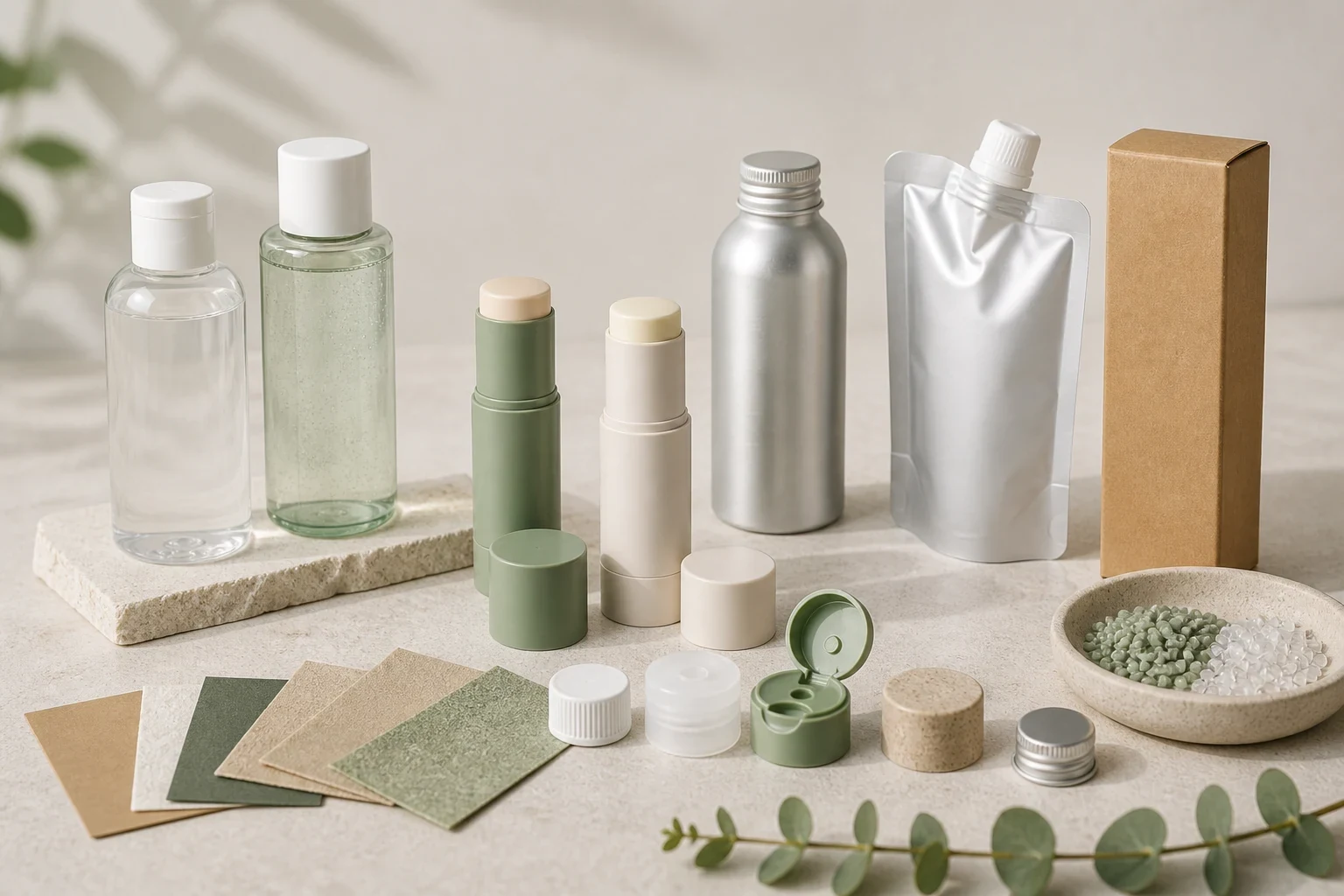
Cosmetic packaging material choices should be reviewed as a complete package system, not only as a base material.
Source and claim note
This guide uses research checked in May 2026 and follows qualified environmental-claim wording based on FTC guidance. It treats sustainable material selection as a package-specific decision: any exact recycled-content percentage, certification, or recyclable claim should match the final package, component set, documentation, and selling market.
| Source | What it means for packaging buyers | Buyer takeaway |
| FTC Environmental Claims: Summary of the Green Guides | Broad "green" claims should be qualified; recyclable, recycled-content, refillable, compostable, degradable, renewable-material, and source-reduction claims need substantiation and careful wording. | Keep environmental claims specific, documented, and tied to the exact package. |
| EPA Sustainable Packaging | Packaging decisions involve production, disposal, waste reduction, material efficiency, and recovery. | Treat this as general packaging context, not proof that a specific package is recyclable. |
| EPA Containers and Packaging Data | Packaging materials include paper, glass, aluminum, plastic, and other categories with different U.S. recovery profiles. | National material data is useful background, but it should not become a SKU-level claim. |
| APR Design Guide Overview | Plastic packaging should be designed for compatibility with recycling systems and postconsumer resin streams. | Review the package as a full system, not only as a bottle or jar resin. |
| APR PET Rigid Guidance | Labels, inks, adhesives, metal decoration, closures, and other components can affect PET package sortation and recycling compatibility. | Check PET bottles together with labels, decoration, closures, pumps, liners, and adhesives. |
| Sustainable Packaging Coalition Materials Matrix | Material choices involve tradeoffs, not simple best/worst rankings. | Compare materials by fit, recovery route, performance, cost, and claim support instead of ranking one material as best. |
| How2Recycle label guidance | Consumer recycling labels use categories such as widely recyclable, check locally, store drop-off, and not yet recyclable. | Use label categories as guidance; package-specific eligibility still needs assessment. |
Quick comparison: common sustainable packaging material options
| Material or approach | Common beauty packaging formats | Good fit when | Main caveat | Claim wording to handle carefully |
| PET | Toner bottles, cleanser bottles, clear jars, travel packs | The brand needs clarity, product visibility, light weight, and access to established PET recovery streams. | The full package still matters: cap, pump, label, adhesive, ink, color, residue, and size can affect recovery. | Avoid "recyclable everywhere." Use qualified recyclable claims only with support. |
| PCR plastic | Bottles, jars, caps, tubes, some component systems | The brand wants recycled content and can accept possible color, clarity, supply, MOQ, and performance constraints. | Actual PCR percentage, resin type, source, color, and performance need supplier documentation. | State the material and verified percent, such as "made with X% post-consumer recycled PET," when substantiated. |
| PP / PE / HDPE | Jars, caps, closures, tubes, tottles, squeeze bottles | The formula or dispensing system needs flexibility, chemical resistance, squeeze performance, or closure compatibility. | Recycling outcomes vary by format, color, size, local collection, and component mix. | Avoid treating the resin code as proof that the finished package is recyclable. |
| Glass | Serum bottles, oil bottles, cream jars, premium skincare jars, fragrance-adjacent packs | The brand needs a premium feel, product visibility, barrier benefits, or formula compatibility. | Glass is heavier and more fragile; closures, droppers, labels, coatings, residue, and local recovery still matter. | Avoid "glass is always greener" or "always recyclable" language. |
| Aluminum | Bottles, jars, tins, tubes, refillable-style packs | The brand wants a lightweight metal look, durability, opacity, and strong material-level recyclability potential. | Liners, coatings, closures, residues, dents, decoration, and local systems affect package-level claims. | Avoid saying every aluminum cosmetic package is recycled in practice. |
| Paperboard / carton | Folding cartons, set boxes, sleeves, inserts, outer packaging | The brand needs secondary packaging, retail display, protection, instructions, or reduced plastic in outer packaging. | Paperboard usually does not replace primary formula-contact packaging for liquids, oils, creams, or wet products without barriers. | Qualify recycled content, responsible sourcing, coating, and recyclability claims. |
| Mono-material design | Bottles, jars, sticks, closures, some refill components | The brand wants to simplify material sorting by reducing mixed-material assemblies. | A mono-material component is not automatically a mono-material full package. Pumps, springs, liners, labels, and decoration can change the story. | Avoid "mono-material equals recyclable everywhere." |
| Refillable system | Durable outer packs, cartridges, refill pouches, jars, bottles, sticks | The brand has a real refill product, a realistic refill route, and clear consumer instructions. | Refillability depends on system design, hygiene, consumer adoption, shipping, and refill availability. | Avoid "refillable" as an unqualified claim unless the refill system exists. |
| Lightweighting / source reduction | Bottles, jars, tubes, caps, cartons | The brand can reduce material while keeping protection, dispensing, decoration, and durability. | The comparison point must be clear, and lighter is not automatically better for every product. | Claims need a clear comparison, such as "uses X% less plastic than our previous pack," when substantiated. |
PET and PCR plastic: useful, but documentation matters
PET remains common in beauty and personal care packaging because it can be clear, light, durable, and suitable for many bottle and jar formats. It can work well for toners, cleansers, mists, gels, and some skincare products when the formula, fill process, closure, and decoration method are compatible.
PCR plastic adds a different question. The buyer is no longer asking only "Can this package hold the product?" The buyer also needs to know:
Which resin contains PCR.
Whether the PCR is post-consumer, post-industrial, or another recycled-content stream.
What percentage is used in each component.
Whether color, clarity, odor, mechanical strength, or decoration changes.
Whether the supplier can provide documentation for the claim.
Whether the material meets the formula and filling requirements.
For PCR claims, keep the wording specific. If the package is documented, a clearer statement is: "Bottle made with X% post-consumer recycled PET." The percentage, resin, and component should match the supplier documentation for that exact bottle, jar, tube, or closure.
For JPS buyers comparing plastic packaging materials, PCR is usually a sourcing and testing decision, not just a marketing decision. Ask about resin route, PCR percentage, available colors, decoration compatibility, lead time, MOQ, and sample testing before locking the claim.
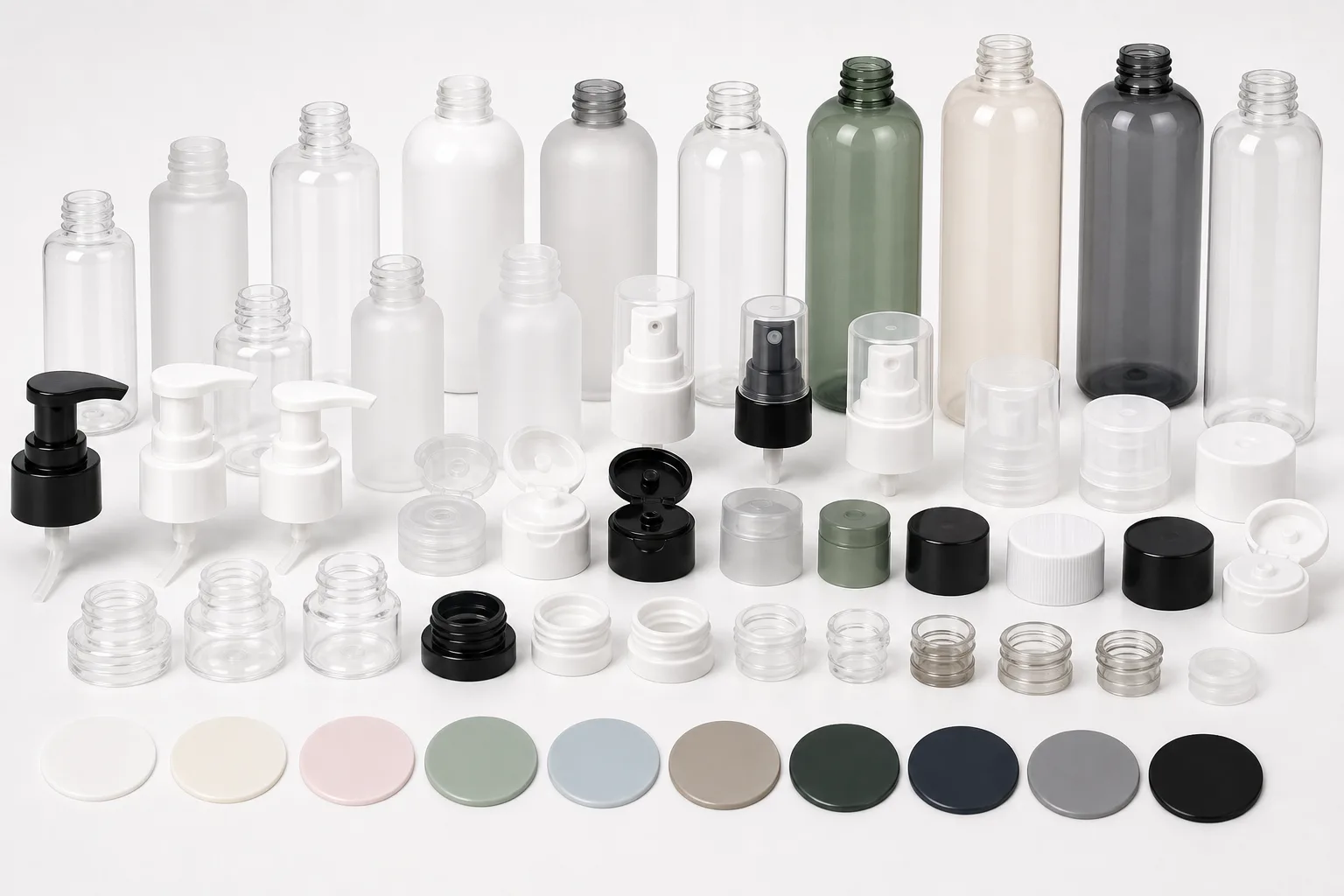
Plastic bottle, closure, and color choices should be reviewed together because PCR route, decoration, and component matching can change the practical MOQ and claim wording.
Recyclable cosmetic packaging: the full package matters
A cosmetic package is rarely just one material. A bottle or jar may include the base resin, cap, pump, spring, dip tube, liner, label, adhesive, ink, coating, metallization, overcap, and product residue. APR guidance for PET packaging shows why labels, inks, adhesives, metal decoration, and sortation behavior can affect recycling compatibility.
That means a base material can look promising while the finished package still needs review.
| Package element | What to check | Why it matters |
| Base container | Resin, color, opacity, size, shape, and wall thickness. | Sorting and reprocessing often depend on the main container material and how it is detected. |
| Closure or pump | Resin, metal spring, dip tube, liner, actuator, overcap, and separability. | Mixed materials and small parts can affect recovery or require different disposal instructions. |
| Label or sleeve | Substrate, coverage area, adhesive, ink, and whether it separates in the intended recycling process. | High label coverage, paper labels, metalized labels, or incompatible adhesives can create problems. |
| Direct decoration | Ink, coating, hot stamp, metallization, or surface treatment. | Decoration can affect sortation, wash behavior, or material quality. |
| Product residue | Oils, waxes, pigments, glitter, actives, or thick formulas. | Residue may reduce acceptance or contaminate the recycling stream. |
| Local access | Market, state, retailer, and municipal recovery realities. | A claim may need qualification if appropriate recycling access is limited. |
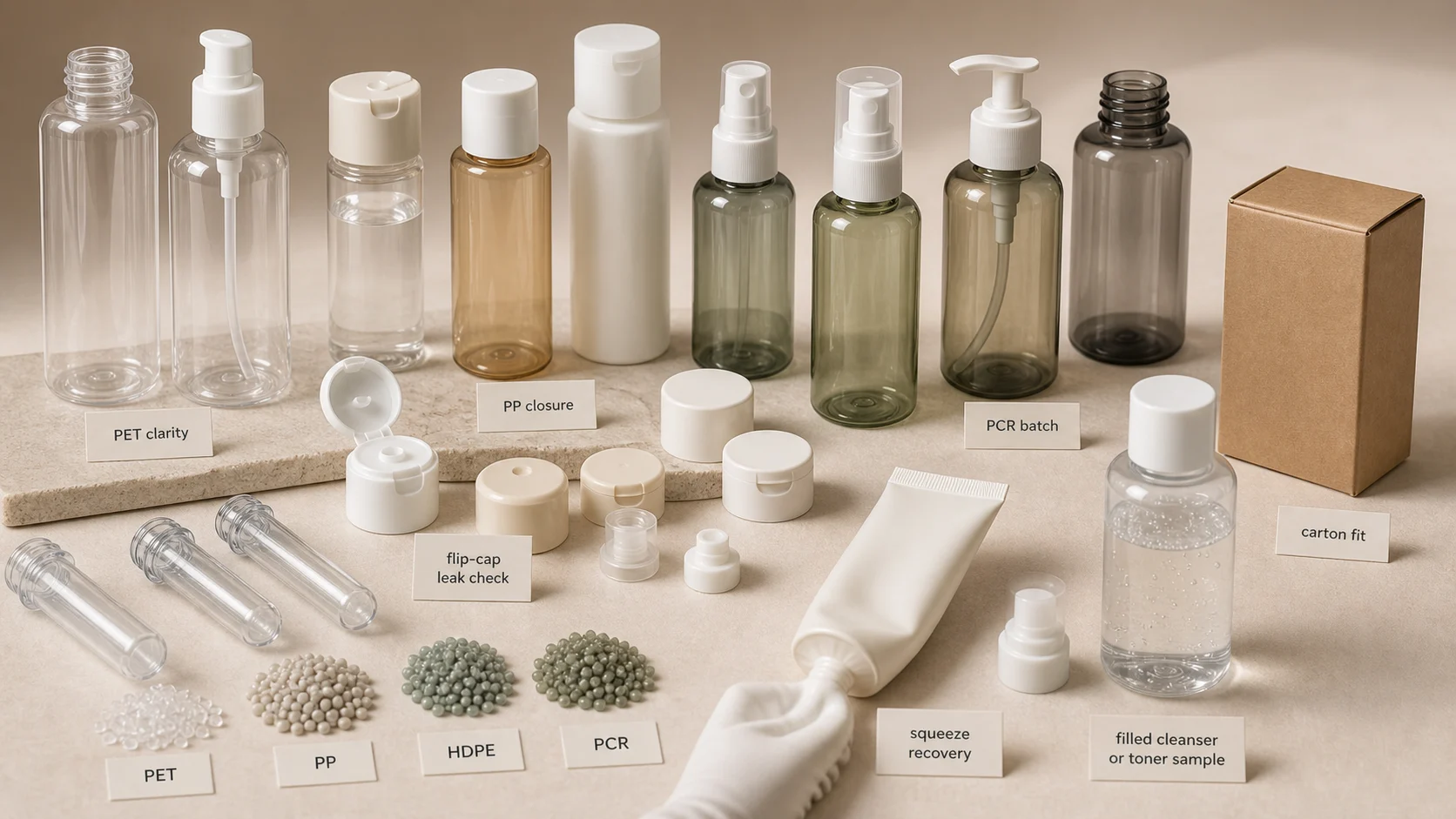
A recyclable or recycled-content claim depends on the complete package, including bottle resin, cap, pump, label, decoration, carton fit, and filled-sample checks.
For packaging copy, do not use a recycling symbol or "100% recyclable" just because the main container is PET, glass, aluminum, or paperboard. Ask whether the full package has been assessed and what claim wording is supportable.
Glass vs. plastic vs. aluminum: there is no universal winner
Beauty brands often ask whether glass, plastic, or aluminum is the most sustainable choice. The honest answer is that it depends on the package, product, shipping model, claim, and recovery pathway.
Glass can suit premium skincare, oils, serums, and fragrance-adjacent products. It can feel substantial and may offer good formula compatibility, but it is heavier and more breakable than many plastic or aluminum options. A decorated glass jar with a mixed-material cap still needs package-level review.
Plastic can be light, flexible, clear, squeezable, and practical for pumps, caps, tubes, and travel formats. It may support PCR content in some formats. The tradeoff is that recyclability and recycled-content claims need careful documentation, especially when the package includes labels, pumps, coatings, dark colors, or mixed materials.
Aluminum can be useful for bottles, jars, tins, tubes, and opaque packs where a metal look, durability, or lightweighting is part of the design brief. Aluminum as a material has strong recycling potential, but a cosmetic package may include liners, coatings, closures, labels, or product residue that affect the actual claim.
Use glass packaging materials, plastic packaging materials, and aluminum packaging materials as material starting points. The final decision should be made by package format, fill product, decoration route, and claim support.
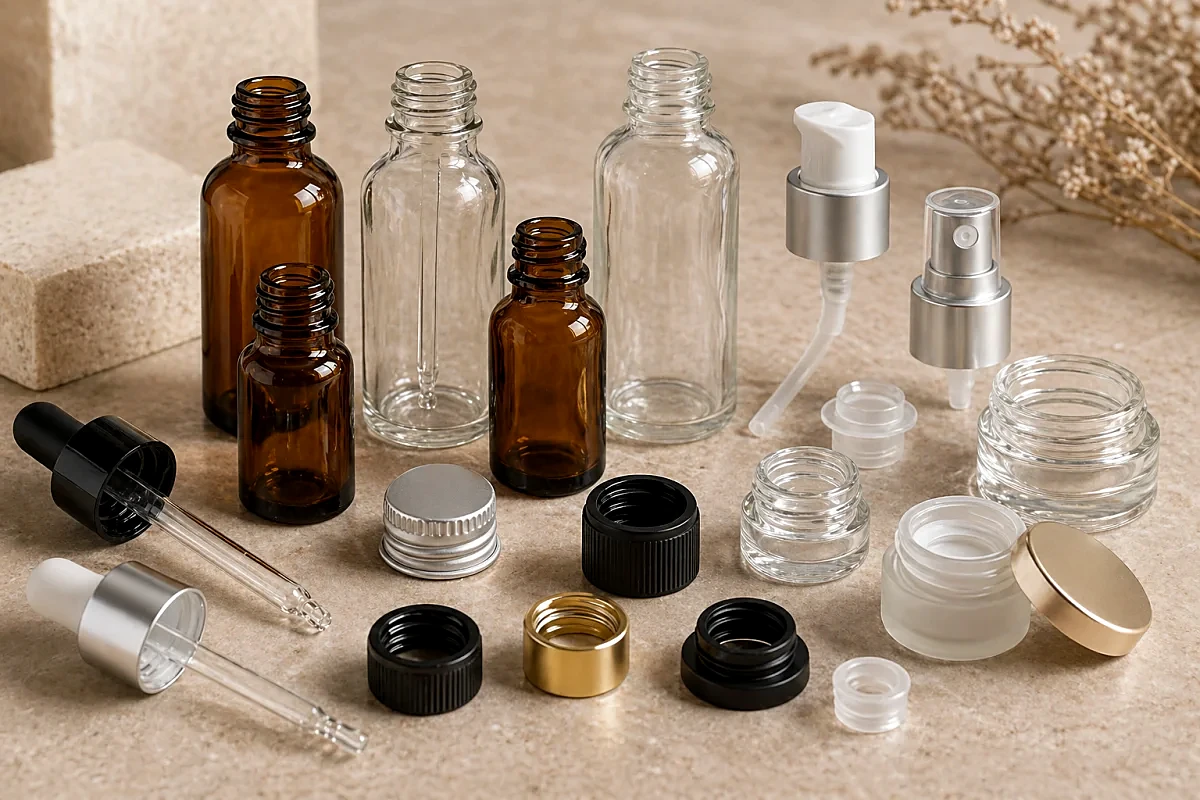
Glass jars, droppers, pumps, caps, and liners should be checked as a matched set, especially for formulas that are oily, fragranced, active-heavy, or sensitive to leakage.
Paperboard and cartons: strong secondary packaging, limited primary-pack use
Paperboard can be a good choice for secondary packaging: folding cartons, sleeves, set boxes, inserts, shipping displays, and instruction panels. It can also help reduce reliance on plastic in outer packaging when the carton is right-sized and designed with suitable coatings, inks, and sourcing documentation.
For primary cosmetic packaging, paper and paperboard have limits. Creams, liquids, oils, gels, sticks, and wet formulas usually need a primary container, liner, barrier, or inner component that can handle formula contact, moisture, filling, shipping, and shelf life. A paper carton may improve the full packaging system, but it does not automatically make the primary package more sustainable.
When using cartons, ask:
Is the carton primary, secondary, or shipping packaging?
Does it use recycled content or responsibly sourced fiber?
Are coatings, laminations, windows, foil, or plastic inserts required?
Can the carton protect the bottle, jar, tube, or stick during transit?
Does the carton create space for instructions, warnings, barcode, lot code, or claim explanation?
For carton and set-box planning, connect the article to cosmetic and personal care packaging formats or custom decoration and packaging customization only after the material decision is clear.
Mono-material packaging: helpful simplification, not a guarantee
Mono-material packaging aims to reduce mixed-material complexity. In beauty packaging, this may mean using the same resin family for the container and closure, or simplifying a component so it is easier to sort or process.
The important distinction is component vs. complete package:
A mono-material cap does not make the whole pack mono-material.
A bottle and closure may align, while a pump spring, label, adhesive, liner, or metallized decoration changes the package system.
A package can be simpler without being recyclable everywhere.
Mono-material design is worth considering for plastic bottles for beauty and personal care, plastic jars for skincare and personal care, sticks, caps, and some refill components. Treat it as a design direction that needs review, not a finished claim.
Refillable packaging: a system, not just a durable container
Refillable packaging can reduce primary-pack waste when the whole system works. The package alone is not enough. FTC guidance says unqualified refillable claims should not be made unless there is a way to refill the package, such as a collection/refill system or a refill product sold for that use.
For beauty packaging, review:
Is there a real refill product, cartridge, pouch, pod, or bulk refill route?
Can the consumer refill the package without leakage, contamination, or confusion?
Does the format make sense for the formula and hygiene expectations?
Will the refill be available where the original product is sold?
Does the refill pack create its own material or waste tradeoffs?
What instructions will appear on the carton, insert, label, or product page?
For refillable jars, sticks, and bottles, keep the claim specific. "Designed for use with replacement refills sold by the brand" is safer than a broad "refillable and sustainable" claim, provided the system actually exists.
Lightweighting and source reduction: useful when the comparison is clear
Reducing packaging weight can be useful when it maintains protection, decoration quality, closure fit, and product performance. For example, a lighter bottle or thinner carton may reduce material use compared with a previous version. But lightweighting can also create problems if the package dents, cracks, leaks, collapses, loses shelf presence, or needs extra shipping protection.
A source-reduction claim needs a comparison point. Before using it, define:
The previous package or benchmark.
The exact component being compared.
The material reduction percentage, if claimed.
Whether protection, filling, decoration, and transport have been tested.
Whether the claim appears on packaging, product pages, retailer listings, or ads.
Do not turn "lighter" into "more sustainable" unless the brand has the evidence to support the broader claim.
Decoration can affect recyclability and claim risk
Decoration choices are part of sustainable packaging material selection. The same base bottle can behave differently after labels, coatings, sleeves, foil, metallization, hot stamping, colorants, adhesives, or direct-print inks are added.
| Decoration choice | Buyer question | Claim-safe direction |
| Pressure-sensitive label | What is the label substrate, adhesive, coverage area, and wash behavior? | Ask whether the label system is compatible with the intended recycling pathway. |
| Shrink sleeve | Does the sleeve cover most of the container and interfere with sorting? | Review coverage area, material, inks, and removal instructions. |
| Direct screen print | Do inks affect wash or recyclate quality? | Ask whether ink choice has recycling compatibility data. |
| Hot stamping or metallization | Does metal content affect sortation or recycling? | Treat metalized effects as a design item that needs technical review. |
| Spray coating or frosting | Does the coating affect detection, color sorting, or reuse? | Confirm testing and avoid broad recyclable claims without review. |
| Embossing/debossing | Does it change material compatibility? | Often lower-risk than added labels, but still review readability and function. |
| Pump, cap, or closure decoration | Are decorated components made from different materials? | Review the full assembly, not only the container body. |
This is where custom decoration and packaging customization matters. Decoration should be reviewed for brand impact, print quality, and claim risk before sampling.
Formula compatibility comes before the sustainability claim
A sustainable packaging material still has to protect the formula. Beauty and personal care products can be water-based, oil-based, alcohol-based, surfactant-based, fragranced, pigmented, waxy, high-viscosity, low-viscosity, oxygen-sensitive, light-sensitive, or active-heavy.
Before choosing the material, ask:
Does the formula need light protection, oxygen protection, or barrier performance?
Will oils, fragrance, surfactants, alcohol, or actives interact with the resin, liner, coating, or seal?
Does the viscosity fit a pump, dropper, tube, jar, stick, or tottle?
Does the material need stress-crack, leak, drop, compatibility, or stability testing?
Can the decoration survive filling, shipping, handling, and consumer use?
Does the closure or dispenser expose metal, elastomer, liner, or adhesive to the formula?
The best material for a claim is not useful if it fails compatibility testing.
Typical MOQ ranges for sustainable packaging material projects
MOQ should be treated as a planning range, not a fixed rule. In cosmetic packaging, the quantity usually changes with mold availability, component count, decoration method, PCR resin batch, color matching, closure or pump choice, and how many SKUs the brand wants to launch together.
| Project route | Common planning range | Why it changes |
| Stock bottle, jar, stick, cap, or standard component | Often 1,000-5,000 pcs | Lower when the component is already available and decoration is simple. |
| Existing mold with custom color, logo, label, or simple finish | Commonly 5,000-10,000 pcs | Color matching, decoration setup, and component matching usually raise the starting quantity. |
| PCR, mono-material, refillable, or special sustainable material route | Often 10,000-30,000+ pcs | Material batch, color tolerance, odor, finish, claim wording, and component matching may need more control. |
| Private mold or proprietary component system | Commonly 30,000-50,000+ pcs, or project-based | Tooling, validation, and repeat-volume expectations matter more than a catalog MOQ. |
Use these ranges only for early budgeting. The actual MOQ should be checked after the material route, package format, decoration, sample plan, and launch timeline are clear.
Supplier checklist before choosing a sustainable packaging material
Use this checklist before approving the package, claim, or artwork.
| Review area | Questions to ask JPS or the supplier | Why it matters |
| Material identity | What resin, glass type, aluminum format, paperboard grade, liner, coating, or closure material is used? | Claims need a clear material basis. |
| PCR content | Which component contains PCR, what percentage, and what documentation supports it? | Recycled-content claims should be specific and substantiated. |
| Recyclability | Has the full package been assessed, including label, ink, adhesive, closure, pump, liner, and residue? | Base material alone is not enough. |
| Formula compatibility | What tests are recommended for this formula and package format? | The package must protect the product before it can support a claim. |
| Decoration | Which decoration routes affect sortation, wash behavior, or component separation? | Decoration can change claim risk. |
| Sampling | Can JPS provide samples for fit, filling, label adhesion, dispensing, leakage, and appearance review? | Buyers need a real sample before production. |
| MOQ and lead time | Are PCR, mono-material, refillable, or custom-decorated options available at the required quantity and timeline? | Sustainable material options may have supply constraints. |
| Claim support | What wording can be supported by supplier declarations, test data, or third-party review? | Prevents unsupported packaging, carton, website, or retailer claims. |
When a project is ready, ask JPS about material, decoration, and compatibility options with the formula type, package format, target material, desired claim, artwork status, and sample deadline.
Safer environmental-claim wording examples
Use these examples as starting points, not finished claim copy. The final wording should match the exact package, selling market, and supporting documents.
| Risky wording | Safer direction when substantiated |
| Eco-friendly packaging | Packaging selected to reduce a specific impact, such as reduced material weight, verified PCR content, or refill compatibility. |
| 100% recyclable | Designed for recyclability, or recyclable where appropriate facilities exist, only when supported by package-level assessment. |
| Made from recycled plastic | Bottle made with X% post-consumer recycled PET, when the resin, component, and percentage are documented. |
| Sustainable glass jar | Glass jar selected for formula compatibility and premium reuse potential, with recyclability dependent on local systems and full package design. |
| Aluminum is infinitely recyclable | Aluminum as a material can be recycled repeatedly, but package-level recovery depends on the format, coatings, closures, residue, and local systems. |
| Plastic-free | Use only if every relevant component is verified and the claim does not mislead about coatings, liners, closures, labels, or secondary packaging. |
| Biodegradable or compostable | Avoid unless the package has competent substantiation, proper facility access, and legal review for the selling market. |
| Refillable | Designed for use with a real refill product or refill system, when that system is available and explained. |
| Uses less material | Uses X% less of a named material than a specific previous package, when measured and documented. |
FAQ
What are sustainable packaging materials?
Sustainable packaging materials are materials and packaging systems selected to reduce a specific environmental impact while still protecting the product. In beauty packaging, that can include PCR plastic, recyclable-design choices, glass, aluminum, paperboard, mono-material components, refill systems, and lightweighting. The claim should be specific, not a broad "green" promise.
What is the most sustainable packaging material for cosmetics?
There is no universal winner. Glass, plastic, aluminum, paperboard, PCR plastic, and refillable systems each have tradeoffs. The better choice depends on formula compatibility, package weight, breakage risk, decoration, shipping, refill behavior, recovery access, and the claim the brand can support.
Is PCR plastic good for cosmetic packaging?
PCR plastic can be a useful option when the package can meet appearance, performance, supply, and compatibility requirements. Buyers should confirm the resin type, PCR percentage, component scope, color or clarity impact, MOQ, lead time, and supplier documentation before making a recycled-content claim.
Is cosmetic packaging recyclable?
Some cosmetic packaging can be recyclable, but the full package has to be reviewed. The container material, closure, pump, label, adhesive, ink, coating, residue, color, size, and local recycling access can all affect the claim. Do not rely on the base material or resin code alone.
Is glass or plastic better for sustainable beauty packaging?
It depends. Glass can offer premium feel and strong formula compatibility, but it is heavier and more fragile. Plastic can be lighter, squeezable, and compatible with pumps and closures, and may support PCR content in some formats. The better option depends on the product, channel, decoration, and substantiated claim.
Is aluminum cosmetic packaging recyclable?
Aluminum as a material has strong recyclability potential, but a cosmetic package should still be reviewed as a finished assembly. Coatings, liners, closures, labels, product residue, and local recycling systems affect what the brand can say.
What is mono-material packaging in cosmetics?
Mono-material packaging reduces mixed-material complexity by using one material family for a component or package system. It can help simplify design, but it does not automatically make the full package recyclable everywhere. Pumps, springs, labels, liners, decoration, and local access still matter.
Are refillable packages sustainable?
Refillable packages can support a lower-waste system when the brand actually provides refills and the consumer can use them safely and repeatedly. A durable container is not enough by itself. The refill format, hygiene, logistics, instructions, and refill availability all matter.
Can paper or cardboard replace plastic cosmetic packaging?
Paperboard is often useful for cartons, sleeves, inserts, and secondary packaging. It usually cannot replace primary formula-contact packaging for liquids, oils, creams, gels, or wet products unless a suitable barrier or inner package is used.
Do labels, inks, pumps, caps, or decoration affect recyclability?
Yes. Labels, adhesives, inks, sleeves, coatings, metalized effects, pumps, caps, liners, and residue can affect sorting, washing, separation, and material quality. Review decoration and component choices before making recyclable or recycled-content claims.
What should I ask a packaging supplier before choosing a material?
Ask for the material, component structure, PCR percentage, supplier declaration, compatibility testing, decoration route, sample availability, MOQ, lead time, and claim support. If the project involves recyclable, recycled-content, refillable, compostable, biodegradable, or source-reduction claims, ask what evidence supports the wording.
Work with JPS on material and compatibility options
If you are choosing packaging for a beauty, skincare, makeup, or personal care product, send the package format, formula type, target material, desired claim, decoration method, artwork status, and sample deadline to JPS. The team can help compare material, decoration, and compatibility options before you lock the package or claim wording.