Packaging decoration and labeling are the decisions that turn a plain bottle, jar, tube, stick, closure, or carton into a shelf-ready cosmetic package. The right route depends on the package material, surface shape, color target, artwork detail, label space, formula exposure, proofing needs, and the claims the brand wants to print. For beauty and skincare buyers, the goal is not to pick the fanciest finish. It is to choose a decoration route that can be sampled, approved, produced, and explained clearly before the launch timeline gets tight.
This guide focuses on decoration and supplier handoff for cosmetic packaging. It is not legal advice about cosmetic labeling requirements. If your question is about required U.S. label content, ingredient declarations, net quantity, warnings, or FDA labeling rules, start with the JPS Packaging guide to cosmetic labeling requirements and review current official sources with your regulatory or legal reviewer.
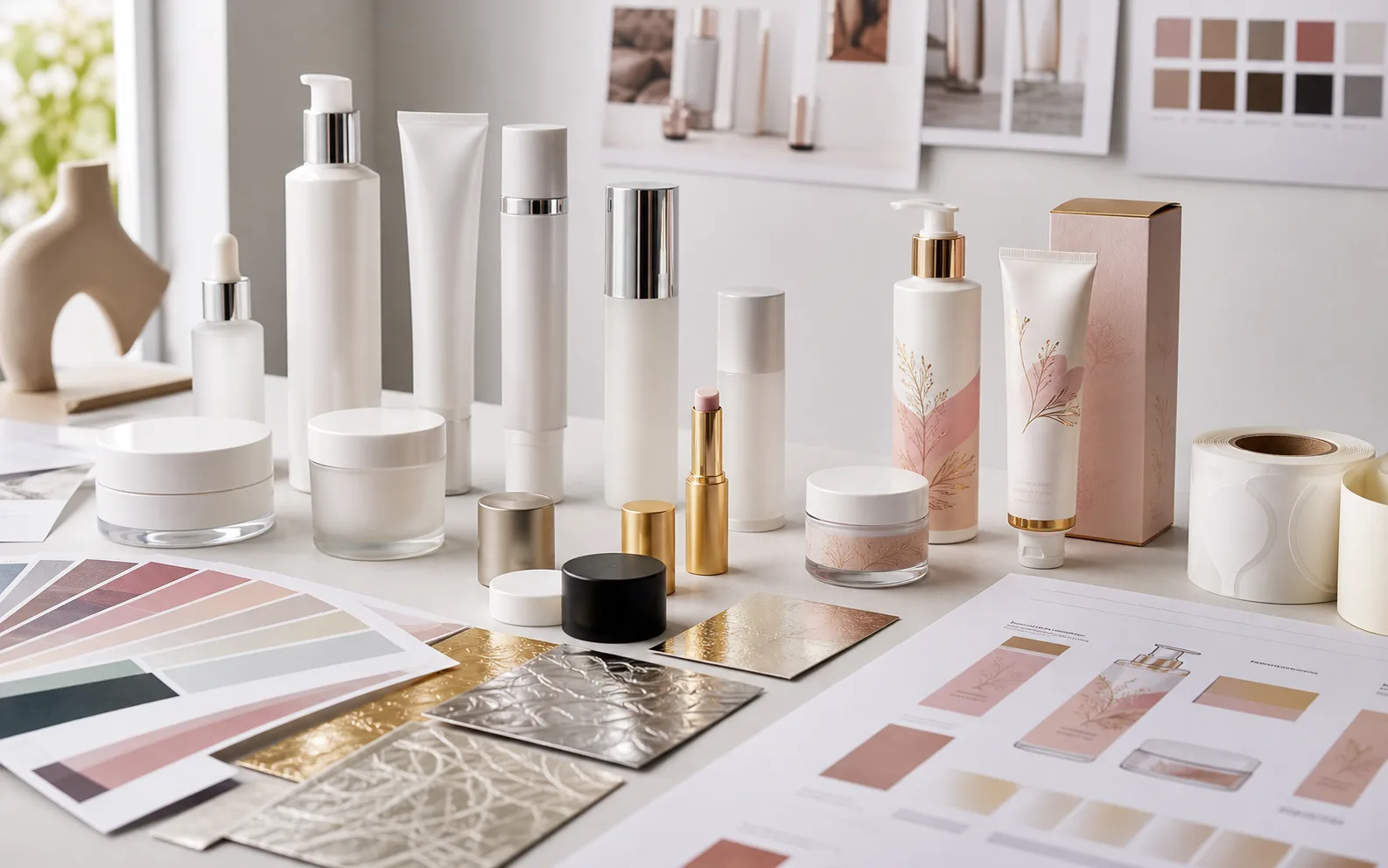
Decoration choices should be reviewed with the package material, artwork, finish target, and approval sample.
Decoration, labels, and legal label review are different jobs
Buyers often use "labeling" to mean three different things. Keeping them separate makes the project easier to brief.
| Work area | What it means | Who should review it |
| Packaging decoration | Surface finish, color, coating, direct print, foil, heat transfer, embossing, debossing, carton print, or other visual treatment on the package. | Packaging supplier, decoration partner, brand team, and sample approver. |
| Physical labels | Adhesive label, pressure-sensitive label, wrap label, shrink sleeve, or label stock applied to a container or carton. | Packaging supplier, label printer, brand team, and sample approver. |
| Cosmetic label compliance | Required label content, claims, warnings, ingredient list, net quantity, responsible-party details, and market-specific rules. | Brand owner, responsible business, regulatory reviewer, and legal reviewer. |
The decoration supplier can help check printable area, finish feasibility, sample quality, and packaging fit. The brand still owns the final wording and compliance review. FDA states that it does not pre-approve cosmetic product labeling, so the safest workflow is to keep decoration approval and regulatory label approval connected but not confused.
For official U.S. compliance context, review the FDA Cosmetics Labeling Guide and 21 CFR Part 701 for cosmetic labeling. For technical background on decoration methods, Plastics Decorating explains that material, part design, ink or coating, and the application process all affect decoration success. These references support the boundary of this guide; they do not replace brand legal or regulatory review.
Start with the package, then choose the decoration method
Decoration should be chosen after the team knows the package format and material. A finish that works well on a glass bottle may behave differently on PET, PP, aluminum, tube laminate, an ABS cap, or paperboard carton. Curved surfaces, small caps, soft tubes, frosted glass, metallic coatings, and oily products can all change the practical choice.
For a broader custom-packaging conversation, use custom cosmetic packaging options to compare structure, material, component, and finish decisions. If the package structure is already close to final and the main question is surface treatment, review cosmetic packaging decoration options.
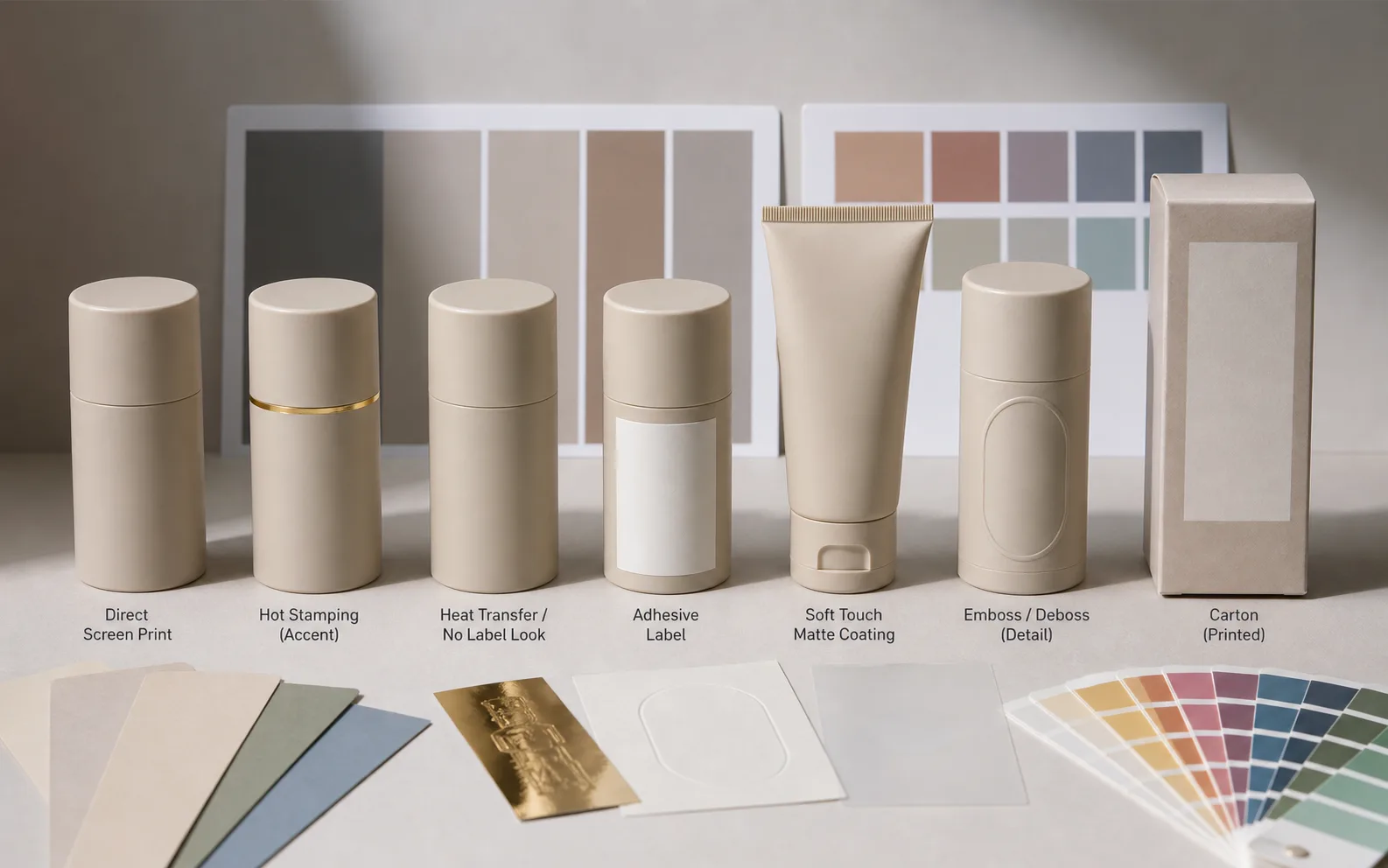
The right decoration method depends on surface shape, color count, finish target, label space, and sample validation.
| Decoration route | Good fit when | What to check before approval |
| Screen printing / silk screen | The design uses solid colors, simple logo work, or direct print on bottles, jars, tubes, or some components. | Print area, color count, registration, surface curve, ink adhesion, rub resistance, and color proof. |
| Hot stamping / foil stamping | The brand wants a metallic accent, premium logo detail, or small highlighted element. | Surface compatibility, foil placement, abrasion risk, edge detail, sample approval, and whether the shape allows clean pressure. |
| Heat transfer | The artwork needs a fuller graphic area, a no-label look, or a film-transferred design on selected shapes. | Film suitability, container shape, heat/pressure behavior, edge visibility, durability review, and supplier capability. |
| Adhesive labels | The product has more copy, multiple languages, smaller run needs, or frequent SKU changes. | Label stock, adhesive, oil/moisture exposure, curved surface fit, label edge, residue, and carton or shower-use conditions. |
| Coating, spraying, frosting, or metallization | The goal is full-body color, soft-touch feel, frosted look, metallic effect, or a stronger shelf presence. | Material compatibility, scratch behavior, color tolerance, sample variation, and how coating affects later printing or claims. |
| Embossing or debossing | The package needs a tactile brand detail, raised/depressed mark, or molded visual cue. | Tooling route, mold or surface area, legibility, change cost, and whether the effect remains clear after filling and handling. |
| Carton print and finishing | The primary container needs secondary packaging, gift-set presentation, instructions, inserts, or retail display. | Board, coating, foil, lamination, insert fit, barcode, claim copy, and consistency with the bottle, jar, or tube. |
Pad printing, laser effects, shrink sleeves, decals, or in-mold decoration may be relevant for some projects, but they should be treated as supplier-scope questions unless the supplier confirms the method, material, and production route.
Labels vs direct decoration
Adhesive labels are often the practical choice when the brand needs more copy, multiple languages, seasonal SKUs, faster artwork changes, or a route that separates label printing from container production. They can also work well when a curved container has enough label area and the label stock is tested for the product environment.
Direct decoration, such as screen printing, hot stamping, coating, or heat transfer, can create a more integrated package look. It may reduce the visible label edge and can feel more premium on glass, plastic, aluminum, tubes, or closures. The tradeoff is that direct decoration often needs more careful sample approval, color review, and production coordination.
| Buyer question | Label route may fit | Direct decoration may fit |
| Does the package need long ingredient copy or multiple languages? | Often yes, because labels can hold more text and change by market. | Sometimes, but limited print area can become a problem. |
| Does the brand want a clean no-label look? | Less likely unless the label is very transparent and tested well. | Often stronger, especially with direct print, heat transfer, coating, or foil. |
| Will the SKU copy change often? | Usually easier to manage. | Changes may require new screens, films, foils, or setup. |
| Is the surface small, curved, or flexible? | Needs label-stock and adhesion testing. | Needs print-area, registration, and method testing. |
| Is the product used around oil, water, shower, or refrigeration conditions? | Label material and adhesive must be tested. | Direct decoration still needs rub, adhesion, and compatibility checks. |
The best answer is often a combination. A skincare line may use direct decoration for the front logo, a small label for required copy, and a carton for longer instructions. A makeup component may use hot stamping on the cap, color matching on the shell, and carton print for shade or retail information.
Material and shape limits matter
Decoration is not only an artwork decision. It is also a surface decision.
| Package material or format | Decoration considerations |
| Glass bottles and jars | Clear, frosted, amber, coated, or sprayed glass can change how ink, foil, label stock, and color appear. Heavy glass also needs handling and carton protection during sample review. |
| PET and other plastic bottles | Surface energy, bottle shape, color, transparency, squeeze behavior, and cap fit can affect printing, labels, coating, and heat-transfer routes. |
| PP, PE, and flexible tubes | Flexing, squeeze recovery, seam position, shoulder shape, and cap orientation can affect label edges, print registration, and finish durability. |
| Aluminum bottles, jars, and tubes | Metallic surface, coating, liner, dent risk, and finish target should be reviewed before choosing print, label, foil, or color treatment. |
| Airless packs and closures | Mixed components can behave differently. A cap, actuator, outer shell, inner bottle, and collar may not accept the same color or decoration in the same way. |
| Cartons and set boxes | Carton decoration must fit the primary pack, inserts, barcode, retail claim copy, and shipping protection. |
For material-specific browsing, buyers can compare plastic cosmetic packaging, glass cosmetic packaging, aluminum cosmetic packaging, cosmetic tube packaging, and cosmetic carton boxes before locking the finish route.
Artwork handoff checklist
Decoration projects move faster when the first supplier brief includes enough technical detail. A mood-board image is useful, but it is not enough for a production proof.
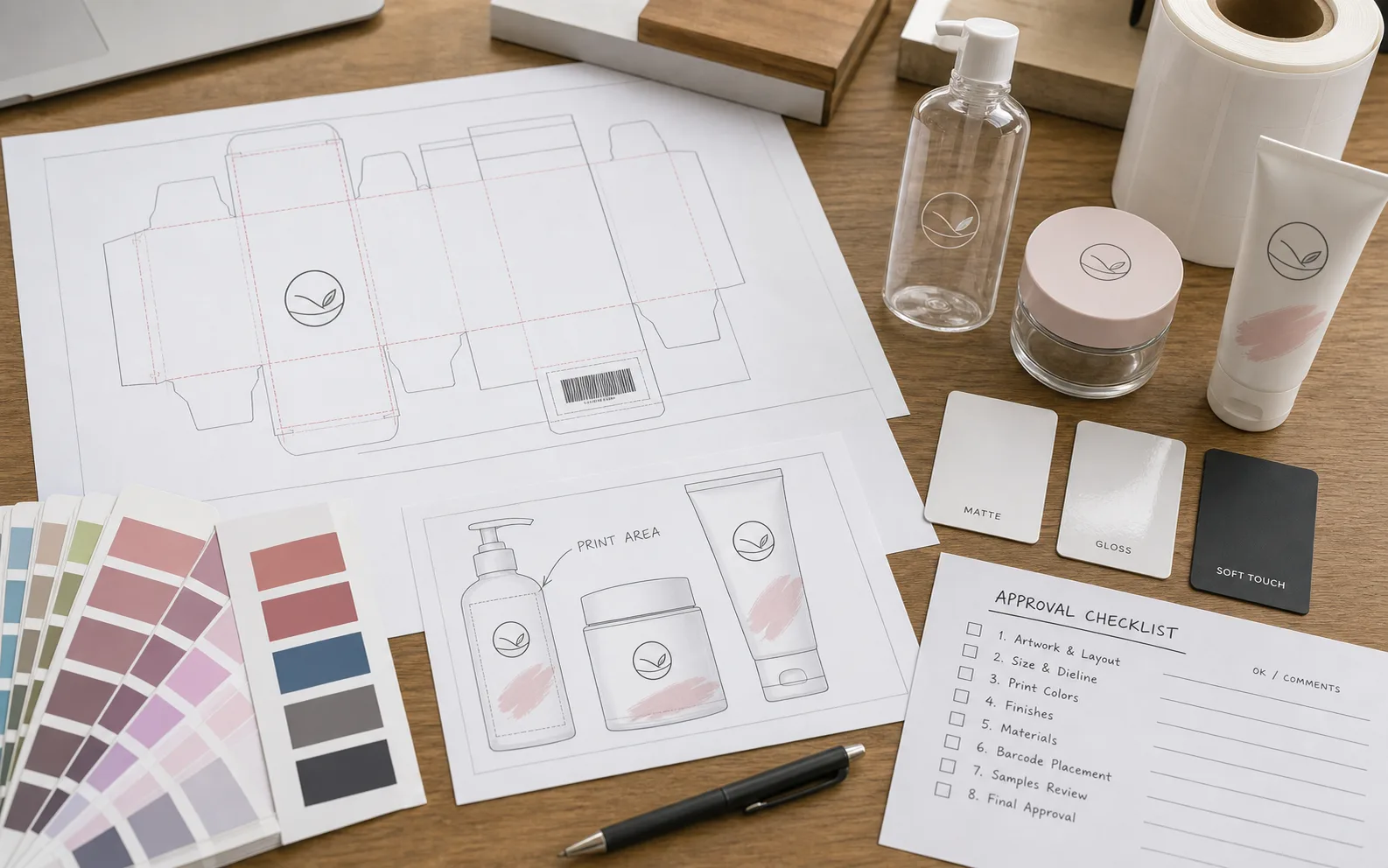
A clear artwork handoff helps prevent rework before physical proofing starts.
Prepare these items before requesting a decoration review:
Package format: bottle, jar, tube, airless pack, stick, closure, carton, set box, or mixed component set.
Material and surface: glass, PET, PP, PE, ABS, aluminum, laminate tube, paperboard, coated surface, frosted surface, or metallic finish.
Capacity and dimensions: size, shape, neck finish, closure, cap, pump, overcap, label area, or carton panel size.
Artwork files: vector logo, dieline if available, print area, copy file, barcode or QR code requirement, and version number.
Color target: PMS-style reference, color chips, previous approved sample, or finish reference. Avoid relying only on screen color.
Decoration goal: direct print, hot stamp, heat transfer, label, coating, metallization, emboss/deboss, carton print, or combination route.
Label and claim review: final copy status, ingredient/legal review status, warning or claim concerns, market requirements, and responsible reviewer.
Sample needs: digital proof, physical decorated sample, color standard, filled-sample check, carton fit, and deadline.
Commercial planning: target order quantity, expected launch window, SKU count, revision risk, and whether MOQ or lead time is a key constraint.
Do not treat proof approval as a formality. The proof is where the brand checks whether the decoration can be read, registered, handled, filled, packed, and sold without rework.
What to check on a physical sample
A digital proof can confirm layout, copy position, color targets, and general appearance. It cannot fully prove how the decoration behaves on the actual package. Physical samples should be reviewed before production approval whenever the finish, material, or launch risk justifies it.
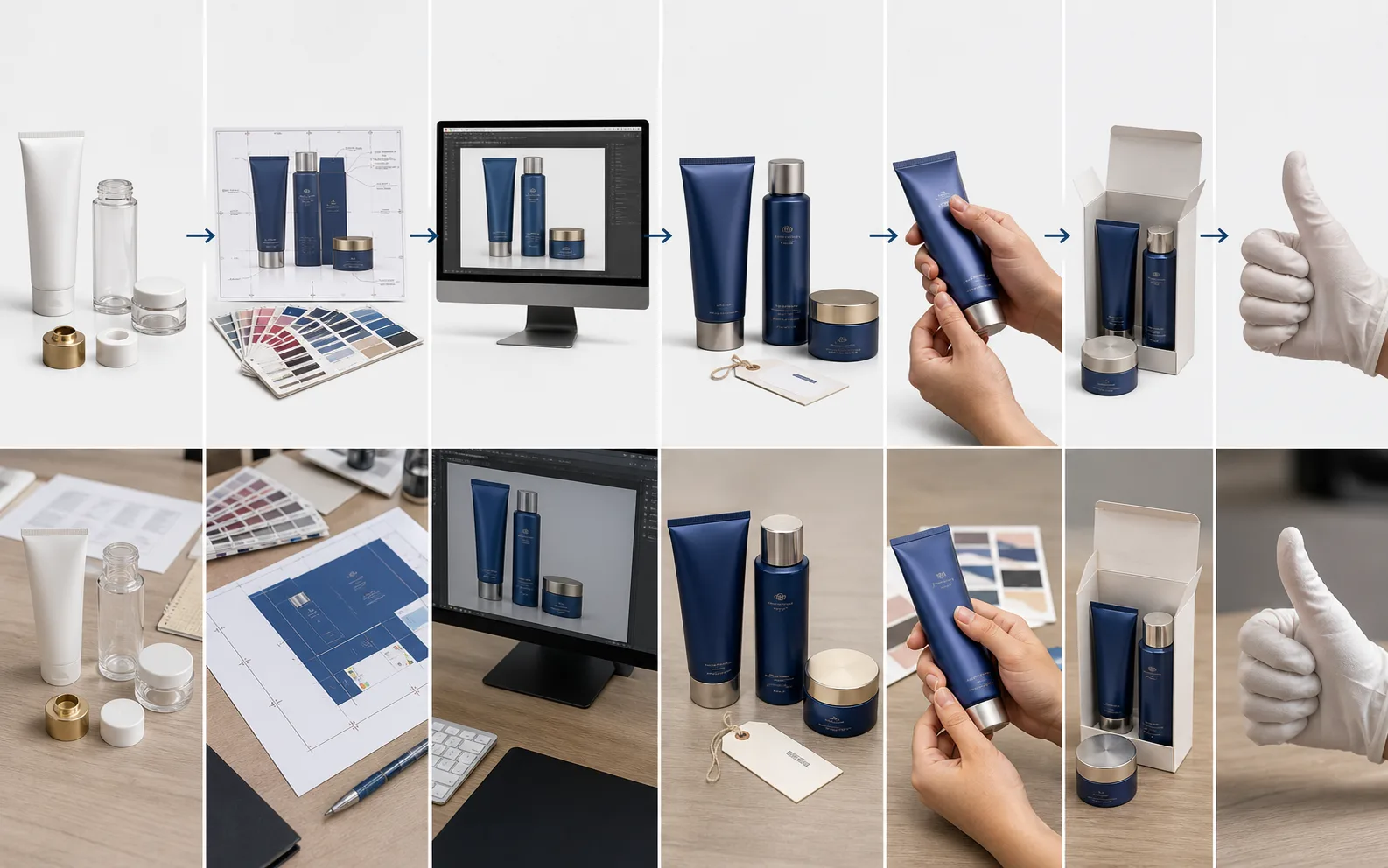
Physical samples should confirm color, readability, registration, decoration fit, and package handling before approval.
| Sample check | What to look for | Why it matters |
| Color | Compare the decorated sample with the approved color target under realistic lighting. | Screen previews do not match every material, coating, or lighting condition. |
| Registration | Check logo placement, multi-color alignment, foil position, label edge, and carton panel alignment. | Small shifts are more obvious on premium cosmetic packaging. |
| Readability | Review contrast, font size, curved surfaces, metallic finishes, frosted surfaces, and label edges. | A beautiful finish can still fail if the copy is hard to read. |
| Adhesion and rub behavior | Ask what sample checks apply to the material and decoration route. | Do not assume scratch or chemical resistance without project-specific review. |
| Formula and handling exposure | Consider oils, alcohol, water, shower use, refrigeration, filling, wiping, and carton movement. | The package is used in real conditions, not only photographed on a desk. |
| Component interaction | Check cap, pump, overcap, dropper, tube shoulder, carton insert, and label clearance. | Components can scratch, cover, or interfere with decoration. |
| Pack-out | Review carton fit, set-box layout, inner tray, shipper, and abrasion during transport. | Decoration problems often appear after packing and movement. |
Use cautious language with durability. It is reasonable to ask about rub checks, adhesion, scratch review, and filled-sample handling. It is not safe to promise that a decoration is waterproof, chemical-proof, scratch-proof, or permanent unless the exact package has supporting test evidence and approved wording.
Color matching across a product line
Cosmetic packaging often includes a bottle, jar, tube, closure, pump, carton, and label in the same line. A single color target can look different across glass, plastic, aluminum, paperboard, soft-touch coating, matte finish, glossy finish, and foil.
For that reason, color matching should be treated as a sample approval process, not a screenshot decision. Give the supplier the reference color, but also approve real parts. If the line uses several materials, review them together. A cap that looks warm beside a cool-toned bottle can make the whole package feel mismatched even if each part looks acceptable on its own.
Practical color checks include:
Compare samples under daylight and retail-style lighting.
Review wet, oily, or handled surfaces if the product environment matters.
Keep an approved sample as the reference for production.
Confirm whether the same finish is realistic across primary container, closure, and carton.
Decide which component is the master reference if perfect cross-material matching is not possible.
Decoration and labeling can affect planning
Decoration can change sourcing complexity even when the base package is a stock component. A stock bottle with no print is a different project from the same bottle with a custom color, foil logo, adhesive label, carton, and proofing cycle.
Instead of asking only "What is the MOQ?" or "What is the lead time?", ask which route the project belongs to:
| Route | What changes planning |
| Stock component with simple label | Label material, label size, artwork version, adhesive fit, and application method. |
| Stock component with direct print | Screen setup, color count, print area, registration, ink behavior, and physical proofing. |
| Stock component with coating or hot stamping | Finish approval, foil behavior, surface compatibility, sample timing, and abrasion review. |
| Multi-component line | Color matching across bottle, jar, tube, closure, and carton. |
| Custom shape or special surface | Tooling, decoration feasibility, revision cycle, and validation before bulk production. |
Actual MOQ and lead time are project-dependent. They can change with component availability, decoration method, number of SKUs, color count, sample approval, artwork revisions, factory schedule, and destination market. Before you use a number in a launch plan, ask the supplier to confirm the route, sample steps, and approval deadline.
Supplier brief: what to send to JPS Packaging
When your project is ready for review, send the packaging team enough detail to narrow the method instead of guessing from a mood board.
| Brief item | Example information |
| Product and formula | Serum, cream, cleanser, sunscreen-adjacent, facial oil, balm, lipstick, deodorant stick, body care, fragrance-adjacent product. |
| Package format | Bottle, jar, tube, airless pack, stick, cap, pump, dropper, carton, set box, or mixed set. |
| Material preference | Glass, PET, PP, PE, aluminum, tube laminate, paperboard, or "open to supplier recommendation." |
| Decoration target | Screen print, hot stamp, heat transfer, label, coating, frosted look, metallic effect, carton print, or "not sure yet." |
| Artwork status | Final vector file, draft logo, dieline available, copy pending, regulatory review pending, or early concept only. |
| Color and finish reference | Color chip, previous sample, PMS-style target, matte/gloss target, foil reference, texture reference. |
| Launch and sample needs | Sample deadline, approval meeting, target market, SKU count, expected order quantity, and whether timing is flexible. |
If the package format is still open, start by comparing cosmetic packaging products. If the structure is set and the main question is finish, review custom cosmetic packaging decoration options. When you have the component, finish direction, artwork status, and sample deadline ready, share the decoration brief with JPS Packaging so the team can review the practical next step.
FAQ
What is packaging decoration and labeling for cosmetic packaging?
It is the process of adding brand appearance and information to a cosmetic package. Decoration can include screen printing, hot stamping, heat transfer, coating, embossing, debossing, or carton finishing. Labeling can mean a physical adhesive label or the legal label content a brand must review. Keep the decoration method, physical label, and compliance review separate.
Which decoration method is best for cosmetic bottles, jars, or tubes?
There is no universal best method. Screen printing may fit simple direct-print logos. Hot stamping may fit metallic accents. Heat transfer may fit fuller graphics or a no-label look on suitable shapes. Adhesive labels may fit more copy, multiple markets, or smaller SKU changes. The right method depends on material, surface shape, artwork detail, exposure conditions, sample approval, MOQ route, and launch timing.
What is silk screen printing on cosmetic bottles?
Silk screen printing, often called screen printing, applies ink directly through a screen onto the package surface. It is commonly discussed for bottles, jars, tubes, and some components. Buyers should check print area, color count, registration, surface curve, ink behavior, and sample approval before production.
When should a brand use hot stamping?
Hot stamping is useful when the package needs a metallic logo, foil accent, or premium detail. It should be checked on the actual surface because heat, pressure, foil behavior, component shape, and abrasion can affect the final result.
How does heat transfer labeling work?
Heat transfer applies a pre-printed film or transfer layer to a package using heat and pressure. It can create a more integrated graphic than a standard adhesive label on suitable containers. Buyers should confirm the package shape, surface, film behavior, edge appearance, durability review, and supplier capability before choosing it.
Should I use adhesive labels or direct printing?
Use adhesive labels when the project needs more copy, multiple language versions, frequent SKU changes, or a more flexible label-printing route. Use direct decoration when the package needs a cleaner no-label look, premium finish, foil detail, or stronger integration with the component. Many cosmetic packages use both.
Can multiple decoration methods be combined?
Yes, many projects combine methods, such as coating plus hot stamping, screen printing plus a carton, or a label plus a decorated cap. The tradeoff is that every added method adds approval steps, sample checks, and potential timing risk.
How do I keep color consistent across bottles, jars, tubes, and cartons?
Use physical samples, not only digital previews. Give the supplier a color target and review real components together under realistic lighting. Glass, plastic, aluminum, paperboard, matte coatings, glossy coatings, and metallic effects can all make the same target color appear different.
What should be checked in an artwork proof?
Check the print area, dieline, logo position, copy, barcode or QR code, color target, finish reference, label edge, legal copy status, SKU version, and approval date. For physical samples, also check readability, registration, adhesion, rub behavior, component fit, carton fit, and handling exposure.
Does FDA pre-approve cosmetic product labels?
FDA says it does not pre-approve cosmetic product labeling. The responsible business must make sure the label is proper for the product and market. Use packaging suppliers for decoration feasibility and proofing support, but keep legal labeling review with the brand's regulatory or legal reviewer.
Does decoration affect MOQ or lead time?
Yes, decoration can affect both, but the answer is route-specific. A simple label on a stock component, direct printing, coating, hot stamping, multi-component color matching, and private mold work can follow different planning paths. Ask the supplier to confirm the project route, sample steps, artwork deadline, and approval timing instead of assuming one fixed MOQ or lead time.