Sample size packaging should be chosen around the job the pack must do—not simply around the smallest container a supplier can provide. A one-use sachet, a seven-day skincare trial, a paid travel SKU, and a five-product discovery set need different dose control, reclosure, filling, label space, and approval checks.
For beauty and personal-care teams, the fastest route to a workable short list is to define the program first, then compare formats against the actual formula, number of uses, filling route, and distribution method.
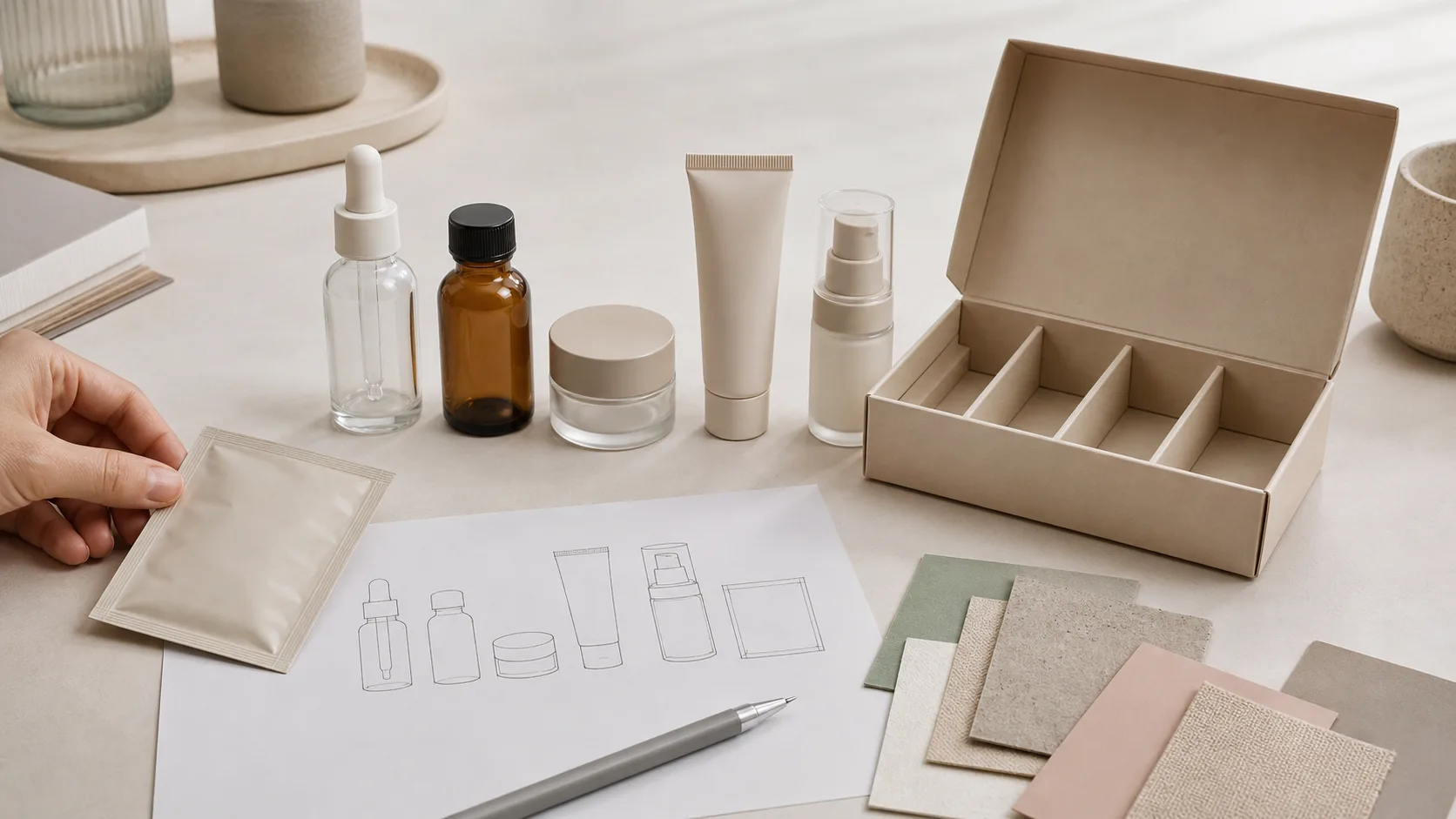
Quick Answer: Start With the Program Type
| Program | Typical user experience | Packaging priority | Common routes to evaluate |
|---|---|---|---|
| Free sample | One application or a small number of uses | Controlled amount, low pack weight, easy distribution | Sachet, pouch, mini vial, small jar, specialty unit dose |
| Trial size | Enough product to judge texture, routine fit, or short-term use | Reclosure, repeated dispensing, realistic use experience | Mini tube, jar, bottle, dropper, pump |
| Paid mini | A small retail SKU that still represents the brand | Decoration, label information, durability, shelf presentation | Decorated bottle, jar, tube, airless format, carton |
| Travel size | Repeated use away from home | Closure security, handling, dispensing, secondary containment | Tube, tottle, bottle, pump, dropper, jar |
| Discovery set | Several formulas used in a sequence or compared side by side | Product identification, order, insert fit, set protection | Mixed minis or unit doses plus carton, tray, or insert |
These names are useful project terms, not universal legal categories. Two teams may use “mini” and “trial size” differently. Put the intended number of uses, selling method, and distribution channel in the brief so every supplier and filler is quoting the same program.
Define the Dose, Duration, and Channel
Nominal fill volume alone does not tell you whether a sample will work. Start with the amount used per application and the number of applications the pack should deliver. A serum trial intended for morning and evening use creates a different dispensing problem from a one-time mask sample, even if both packs are physically small.
Ask five questions before selecting a container:
- Is the product meant for one use, several uses, or a complete trip?
- Does the user need a measured dose, a controlled drop, a spray pattern, or free access to the formula?
- Will the pack be mailed, handed out, inserted into an order, sold individually, or packed in a set?
- Must it stand on a retail shelf, fit a subscription box, or survive loose handling in a travel bag?
- Does the sample need to reproduce the dispensing experience of the full-size product?
This step prevents a common mismatch: choosing a low-cost one-use pack for a formula that needs several applications before a user can judge it, or using an elaborate mini component for a one-time distribution campaign.
Unit Dose or Reclosable Packaging?
This is usually the first structural decision.
| Check | Unit-dose route | Reclosable route |
|---|---|---|
| Intended uses | One use or a defined dose | Multiple applications |
| User exposure after opening | Package is normally discarded after opening | Formula is exposed each time the pack is opened or dispensed |
| Filling route | May require form-fill-seal, sachet converting, or a specialist contract packager | May use bottles, jars, tubes, droppers, pumps, or other rigid components |
| Brand experience | Limited dispensing experience and surface area | Can more closely resemble the full-size pack |
| Artwork space | Often constrained on the primary pack; an outer card or carton may help | Varies by shape; small curved parts still restrict usable space |
| Set assembly | Flat packs can reduce volume | Rigid minis can improve presentation but need secure inserts |
A sachet is not automatically the best sampling format, and a reclosable mini is not automatically more premium. The better route is the one that delivers the intended number of uses without creating an avoidable filling, handling, or approval problem.
Compare Sample Size Packaging Formats
Use the matrix as a shortlisting tool, then review the actual formula in the intended component system.
| Format | Often considered for | Main checks before shortlisting |
|---|---|---|
| Sachet or pouch | One-use creams, gels, liquids, wipes, or campaign inserts | Fill/seal route, laminate selection, opening experience, dose, artwork, outer display format |
| Mini jar | Creams, balms, masks, and scoopable formulas | Finger contact, liner/seal, thread and lid fit, residue, label area |
| Tube | Gels, lotions, creams, cleansers, and repeated-use trials | Orifice, cap, tail seal, squeeze recovery, fill/seal equipment, decoration area |
| Tottle | Squeezable formulas where inverted storage and drainage matter | Formula flow, closure cleanliness, stability, dispensing control |
| Bottle | Toners, lotions, cleansers, oils, and other flowable formulas | Neck/closure match, pour control, headspace, label panel, secondary containment |
| Small brown bottle | Light-sensitive formula directions or a familiar apothecary look | Whether colored glass is technically needed, closure choice, breakage, actual light-protection requirement |
| Dropper bottle | Serums and oils needing dropwise application | Pipette/component fit, dose consistency, wiper behavior, bulb interaction, filled testing |
| Pump or airless format | Multi-use skincare requiring controlled dispensing | Priming, output, residual product, actuator protection, closure/overcap, actual formula behavior |
| Specialty unit dose | Precisely portioned liquids, solids, swabs, or applicator-led samples | Equipment and filling partner, pack opening, dose, component availability, assembly route |
Teams that are ready to compare physical families can browse cosmetic packaging products, then move to a specific category such as plastic bottles for cosmetic packaging, glass bottles for serums and oils, plastic jars for creams and balms, or plastic cosmetic tubes. Treat those pages as component exploration—not proof that a particular mini capacity is available or suitable for the formula.
For detailed jar checks, use the guide to plastic jars and containers for beauty packaging. If inverted squeeze dispensing is under consideration, review tottle packaging for squeezable formulas.
Match the Format to the Formula and Application
The same nominal container can behave differently with a thin toner, a volatile fragrance-adjacent formula, a dense balm, or a product containing oils that interact with packaging materials. Shortlisting therefore needs to cover the complete package: container, closure, liner, plug, wiper, pump, dip tube, applicator, decoration, and any product-contact parts.
Viscosity and flow
Thin formulas may expose weaknesses in an opening or closure that appear acceptable with a cream. High-viscosity products may resist a narrow orifice, fail to prime in a small pump, or leave an unrealistic amount of product in the pack. Define the intended dose and application method before choosing the dispenser.
Light, evaporation, and repeated opening
Small brown bottles and other colored glass sample containers may be considered when light exposure matters, but color alone is not proof of protection. The formula owner should define the sensitivity and the testing conditions. For volatile or alcohol-containing products, material, seal, headspace, and storage orientation also need project-specific review.
Direct access or controlled dispensing
A jar lets the user access most of a thick formula, but repeated finger contact changes the use pattern. A tube, pump, dropper, or unit-dose package limits direct access in different ways, yet none should be described as contamination-proof without evidence. Review the formula, preservation system, expected use period, and dispensing behavior together.
Confirm the Filling and Assembly Route Early
Small packs can require more specialized filling than their size suggests. A sachet may need a converting and sealing line. A mini tube needs a compatible filling and tail-sealing process. A pump may need priming checks. A narrow bottle can create fill-accuracy or foaming issues. A discovery set adds sorting, identification, insert loading, and final pack-out.
Before requesting a quotation, identify who owns each step:
- sourcing the empty primary components;
- confirming product-contact materials and the complete component set;
- pilot or production filling;
- sealing, capping, torquing, or pump assembly;
- decoration and artwork proofing;
- filled-sample evaluation;
- carton, tray, or insert development;
- set assembly, packing, and retained samples.
Do not assume the packaging supplier is also the filler or set assembler. If more than one company is involved, give each party the same drawings, component references, formula information, and approval version.
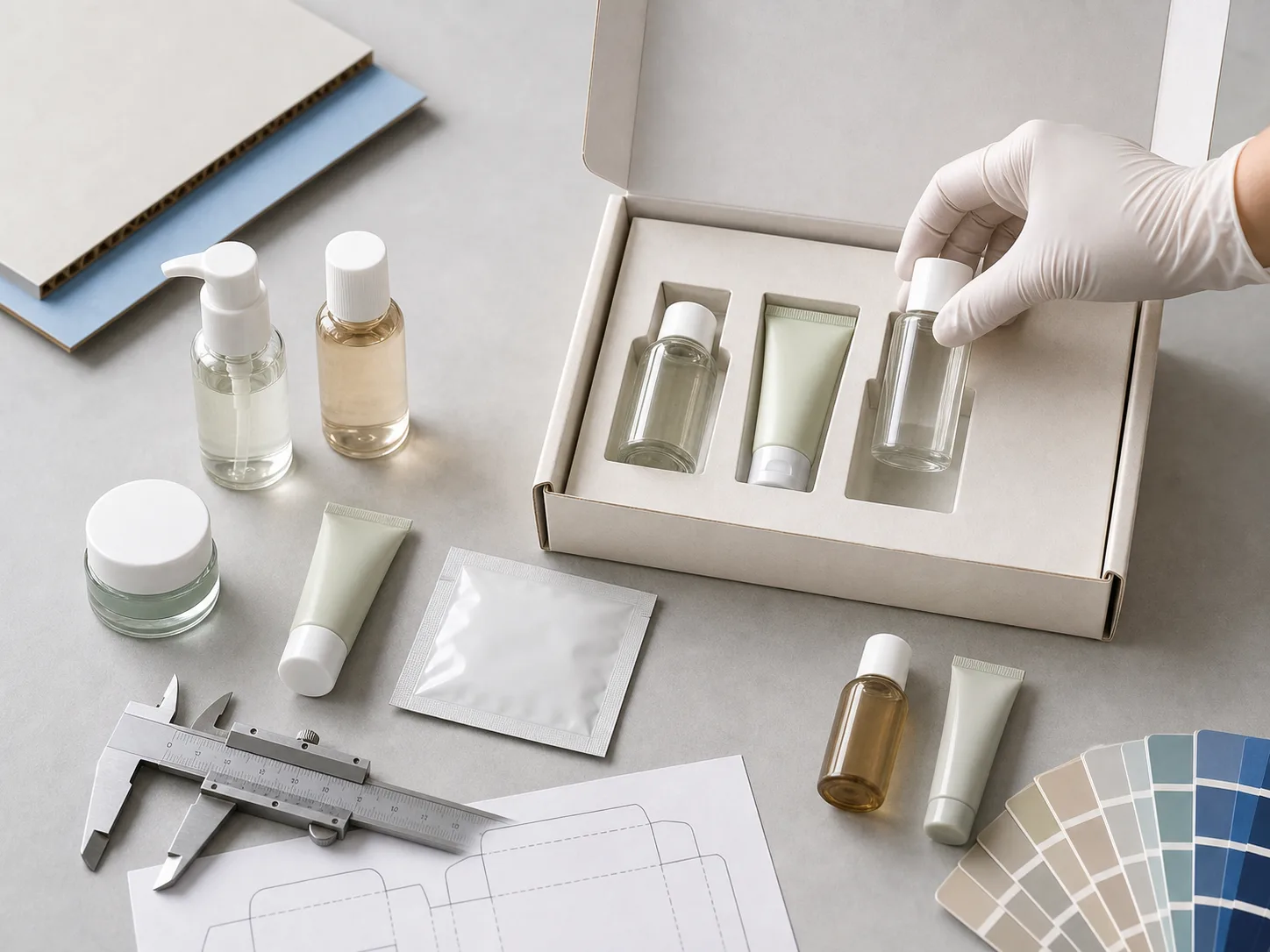
Once the route is defined, share the formula type, target fill, intended number of uses, preferred format, and distribution method to request a packaging fit review. Include whether the project needs empty evaluation samples, decoration proofs, or a discovery-set pack-out review; availability and responsibility remain project-dependent.
Plan Artwork and Label Information on Small Packs
Mini packs lose usable information area quickly. Curved walls, shoulders, seams, caps, and narrow diameters reduce the space that can actually be printed or labeled. A nominally larger format may provide less usable artwork area than a flatter package.
For products sold in the United States, review the FDA's cosmetics labeling regulations and summary of cosmetics labeling requirements before final artwork. The exact panel, type, and retail configuration matter.
The FDA's Cosmetics Labeling Guide describes a limited net-quantity exemption for packages containing less than one-quarter avoirdupois ounce or one-eighth fluid ounce when they are attached to a properly labeled display card or sold in a properly labeled outer container. That is a conditional rule, not a general exemption for every sample. Have the final primary pack, display card, carton, and selling configuration reviewed together.
When the primary pack cannot carry the required information clearly, an outer carton, display card, booklet, or set insert may be part of the labeling plan. Explore cosmetic carton boxes and set boxes after the primary formats and final pack dimensions are known.
Decide How Closely the Sample Should Match the Full-Size SKU
A sample can reproduce the full-size experience, borrow only its visual identity, or use a completely separate distribution format. Decide what needs to stay consistent:
- formula-contact material direction;
- dispensing method and approximate dose;
- package color and finish;
- artwork hierarchy and product identification;
- opening and closing behavior;
- instructions and application method;
- position within a multi-SKU set.
A stock mini with a label may be the practical choice for early market testing, even when the full-size SKU uses a custom component. A paid mini may justify closer visual and functional alignment. If decoration or component matching is important, compare custom cosmetic packaging options only after the functional route is clear.
Approve Filled Samples and the Complete Pack-Out
An empty component can confirm size, appearance, and mechanical fit. It cannot establish how the finished formula will dispense, leak, stain, evaporate, clog, or interact with the package during the intended storage and distribution route.
Use a staged approval sequence:
- Empty component review: confirm the full component set, capacity direction, closure fit, handling, and preliminary artwork area.
- Filled trial: evaluate the actual or representative formula in the intended components under project-defined conditions.
- Dispensing and handling review: check opening, reclosure, dose, priming, residue, orientation, and realistic repeated use.
- Decoration proof: confirm print or label placement, color reference, adhesion, legibility, and scuff risk on the approved structure.
- Pack-out sample: load the final primary packs into the card, carton, tray, or insert and review identification, spacing, orientation, and protection.
- Approval record: retain the approved components, filled sample, artwork, drawings, color references, pack-out photos, and version notes.
For travel-size projects, keep performance and passenger rules separate. The TSA's 3-1-1 liquids rule uses a 3.4 oz/100 ml container limit for liquids, aerosols, gels, creams, and pastes in carry-on baggage. Meeting that size limit does not make a package “TSA approved,” leak-resistant, compatible with the formula, or suitable for retail distribution. Closure security, orientation, headspace, temperature, pressure changes, and secondary containment still need a project-specific review.
Prepare a Sample-Program RFQ
Send the same inputs to every supplier or filling partner so quotations are comparable:
- program type and distribution channel;
- formula category, viscosity direction, and any known sensitivities;
- target fill and intended number of uses;
- preferred format plus acceptable alternatives;
- complete closure, dispenser, applicator, and liner needs;
- primary package and outer-pack labeling plan;
- number of SKUs and discovery-set configuration;
- stock, decorated stock, modified component, or tooling direction;
- initial quantity and forecast, without assuming a fixed MOQ;
- empty, filled, decorated, and pack-out sample needs;
- artwork status, color references, and decoration direction;
- filler, assembly owner, and ship-to market;
- sample deadline and target production date;
- documentation and project-specific evaluation requirements.
If the program is still too early for that list, use the broader beauty product packaging startup brief first. If the inputs are ready, send the formula type, fill target, format, use count, artwork status, quantity route, and sample deadline to JPS Packaging for a project discussion.
FAQ
What is the difference between a cosmetic sample, trial size, mini, and travel-size product?
A sample is commonly used for product introduction and may contain one or a few uses. A trial size is intended to provide enough product for evaluation over several applications. A mini is a general size description and may be free or sold. A travel size is normally designed for repeated use away from home. Because the terms are not always used consistently, specify use count, selling method, and distribution channel in the project brief.
Should a cosmetic sample use a single-use sachet or a reclosable container?
Choose a sachet or other unit-dose route when one controlled application and low pack volume are priorities and the filling route supports it. Choose a reclosable jar, tube, bottle, dropper, or pump when the user needs several applications or the dispensing experience matters. Compare formula behavior, filling, artwork space, and set assembly—not unit cost alone.
Which packaging formats work for liquid, cream, balm, oil, and gel samples?
Liquids may use bottles, droppers, pumps, or flexible unit doses; creams and gels may use sachets, jars, tubes, tottles, or pumps; balms often need jars or specialty solid formats; oils may use bottles or droppers. These are shortlisting directions only. The actual formula and complete component system need filled evaluation before approval.
Does a 100 ml-or-smaller package automatically make a cosmetic product suitable for travel?
No. The TSA's 100 ml/3.4 oz limit concerns what passengers may carry through US airport screening. It does not validate the closure, leakage performance, formula compatibility, labeling, shipping classification, or retail suitability of the package.
What should a beauty brand test before approving filled sample packaging?
The project plan may need to cover formula/package compatibility, leakage, opening and reclosure, dose or dispensing, pump priming, dropper behavior, evaporation or weight change, label and decoration performance, user handling, and complete set pack-out. Test conditions, duration, acceptance criteria, and responsibility should be agreed by the brand, formulator, filler, packaging supplier, and any qualified testing partner.
How can a discovery set keep multiple samples organized and protected?
Give every SKU a clear position and identifier, then check the actual filled packs in the proposed carton, tray, or insert. Review orientation, spacing, cap and pump protection, removal, instructions, artwork sequence, and movement during the intended distribution route. Do not finalize the insert from nominal dimensions alone.
What label information must fit on a very small cosmetic package or its outer carton?
The answer depends on the product, package size, selling configuration, and applicable US labeling rules. FDA guidance covers identity and net-quantity statements and describes limited conditions for very small packages used with a properly labeled display card or outer container. Review the final primary and secondary packaging together with a qualified labeling reviewer.
What project information should be prepared before requesting sample size packaging?
Prepare the program type, formula category, target fill, intended number of uses, preferred format, component and dispensing needs, distribution method, SKU count, outer-pack plan, artwork status, quantity route, filling/assembly owner, sample needs, destination market, and timeline. These inputs let suppliers compare realistic routes instead of guessing from a reference image.