Airless packaging dispenses a formula without using the dip tube found in a conventional lotion pump. In a common piston-based bottle, each pump stroke creates a pressure change that moves an internal disc upward and pushes product toward the actuator. The system can reduce repeated air exchange during use and improve product evacuation, but those benefits still depend on the formula, pump, fill process, and finished-package testing.
For a skincare packaging team, the practical question is not simply "Is airless better?" It is whether an airless bottle or jar solves a real dispensing or product-use problem that a standard pump, tube, jar, or dropper cannot solve as efficiently.
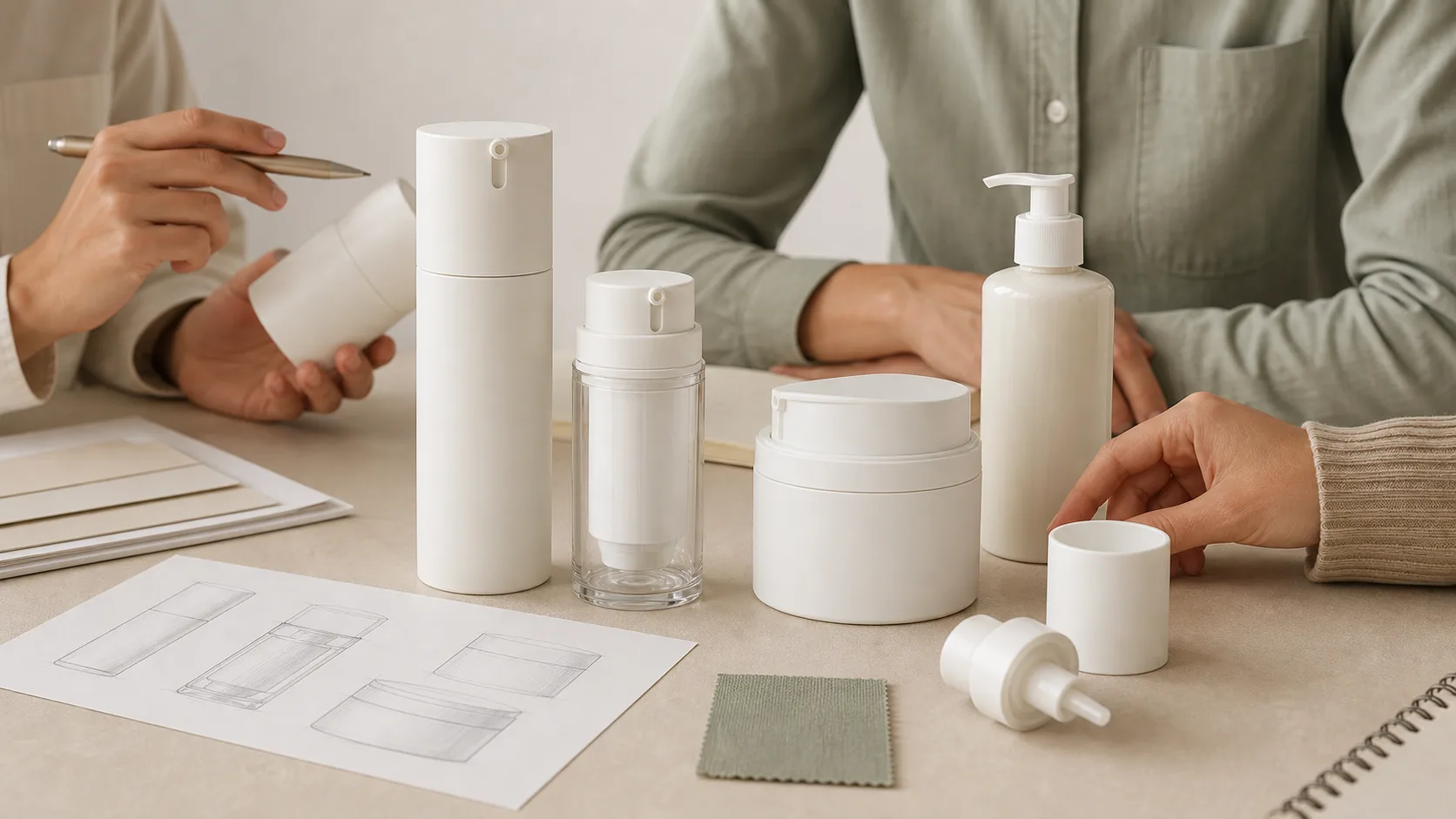
Airless packaging should be selected as a complete system: actuator, pump, piston or inner platform, body, overcap, formula, and filling route all affect the result.
Quick comparison: airless bottle, airless jar, or standard pump?
| Format | How it dispenses | Consider it when | Main sample checks |
| Airless bottle | A piston, disc, pouch, or related system moves product toward the pump without a conventional dip tube | Controlled pump use, reduced repeated air exchange, high product value, or stronger evacuation matters | Priming, piston travel, output, recovery, residual product, leakage |
| Airless jar | A pump top dispenses product from a wider reservoir, often through a platform or valve | The formula is cream-like and the brand wants jar proportions without open-finger access | Platform movement, valve behavior, dose, cleaning around the outlet, residual product |
| Standard pump bottle | A dip tube draws product from the bottom while replacement air enters the headspace | The formula is stable, fill size is larger, cost sensitivity is higher, or familiar lotion dispensing is preferred | Dip-tube length, output, closure fit, leakage, end-of-use evacuation |
| Open jar | The user removes the lid and accesses the formula directly | The product needs wide access, a scoop application, or a familiar balm/cream ritual | Seal and liner, repeated opening, user contact, residue, closure torque |
No format wins every project. An airless mechanism adds components and filling requirements. If those do not solve a real formula, dosing, evacuation, or positioning need, a simpler package may be the better commercial choice.
What "airless" means in cosmetic packaging
In cosmetic packaging, "airless" usually describes a dispensing system designed to limit the amount of outside air exchanged with the product reservoir during use. It does not mean the pack contains no air at any point, creates a sterile environment, or guarantees that oxygen-sensitive ingredients remain stable.
Most buyers encounter one of three broad structures:
Piston or disc systems: a movable platform rises as product is dispensed.
Pouch or bag systems: a flexible inner reservoir contracts as product leaves.
Airless jar systems: a pump top and internal platform or valve dispense a cream-like formula from a wider body.
The exact venting, valve, piston, and filling arrangement varies by package. Ask for the component drawing and filling instructions for the actual SKU rather than assuming every airless pack works the same way.
How a piston-based airless pump bottle works
A typical piston design works like this:
The user presses the actuator.
The pump chamber releases a portion of product through the outlet.
Pressure changes inside the pack draw the internal piston or disc upward.
The rising platform keeps the remaining product close to the pump inlet.
The pump chamber recovers and prepares for the next stroke.
Because the product moves upward from below, the pack does not need a dip tube reaching to the base. This can reduce the familiar end-of-use problem where a conventional dip tube can no longer reach product pooled at a corner. Actual evacuation still varies with formula viscosity, piston fit, body geometry, fill amount, storage orientation, and pump design.
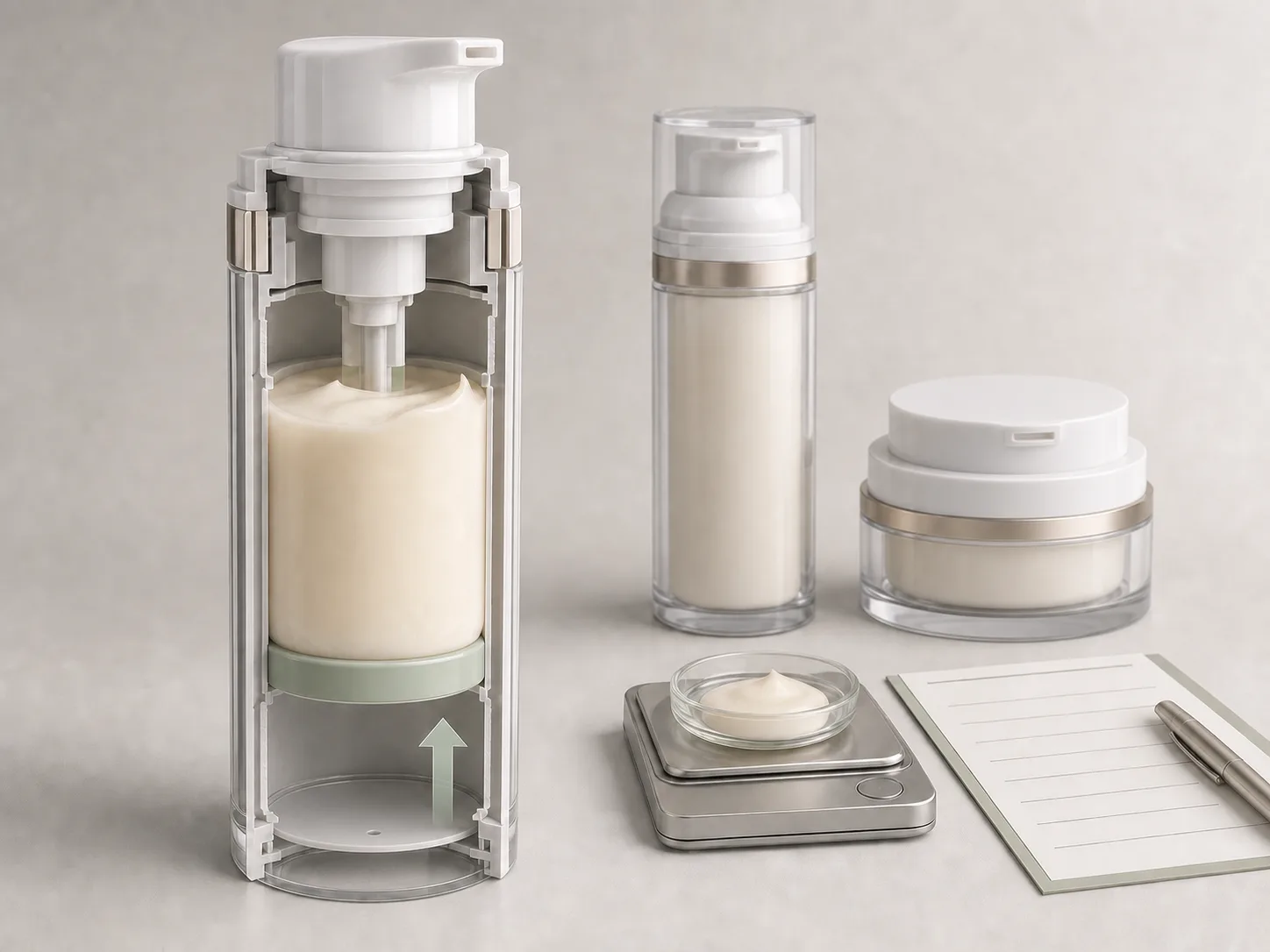
A cutaway view helps explain piston travel, but approval must use the real filled package: check priming, recovery, output, leakage, and residual product under the intended use conditions.
The parts that have to work together
An airless pack is a component system. Treating it as a bottle with a special pump is where projects get into trouble.
| Component | What to define | Common failure signal during sampling |
| Actuator | Shape, force, output direction, lock or overcap | Awkward press, sputtering, product collecting around the outlet |
| Pump chamber and valve | Target output, recovery, formula range | Delayed recovery, inconsistent strokes, loss of prime |
| Piston or internal platform | Travel, seal against the wall, vent path | Drag, tilting, incomplete movement, product bypass |
| Body/reservoir | Fill volume, geometry, product-contact material | Incorrect headspace, deformation, poor visibility of piston travel |
| Base vent | Air path below the piston | Blocked movement or failure to dispense |
| Overcap/collar | Fit, protection, visual alignment | Loose cap, actuator damage, color mismatch |
| Decoration/label | Print area, adhesion, assembly tolerance | Artwork hidden by movement or assembly, scuffing, distorted label |
This is why an empty sample is only an early screening tool. It can show scale, hand feel, and finish; it cannot establish filled dispensing performance.
When airless packaging is worth testing
An airless format is worth a filled trial when several of these conditions are present:
the formula owner wants to reduce repeated air exchange during consumer use;
a consistent pump experience is important to the application instructions;
the product is expensive enough that leftover formula creates a poor user experience;
the formula is a cream, lotion, serum, or gel that may move reliably with the selected mechanism;
the brand wants a contained application rather than repeated finger access;
the product line needs a technical or treatment-led presentation;
a refill cartridge or replaceable inner unit is part of the product concept.
These are reasons to test, not proof of suitability. Airless packaging does not replace formula preservation, stability work, compatibility evaluation, or a qualified assessment of the finished cosmetic.
When another format may be better
A standard pump, tube, dropper, or jar may be the more practical route when:
the product is used in a large amount per application;
the formula contains particles or has a texture that may obstruct the pump path;
a very thin formula does not behave well in the proposed airless system;
the filling partner cannot support the required top-fill, bottom-fill, assembly, or priming process;
the user needs direct scoop access or an applicator ritual;
the project cannot justify the component complexity, MOQ route, or testing work;
the package must be easily refilled by the consumer but the selected airless SKU was not engineered for refill.
Compare airless cosmetic packaging systems only after the formula and use pattern are clear. For lower-viscosity products where the application ritual matters, the guide to dropper bottles for cosmetics explains a different dispensing route. For familiar lotion formats, review pump dispensers for skincare packaging and plastic bottles for cosmetic packaging.
Airless bottle vs airless jar
Both formats can use pump-led dispensing, but their proportions and formula expectations differ.
An airless bottle is usually the first route to evaluate for serums, lotions, treatment products, and creams that can move through a defined pump path. Its taller body can support a familiar one-hand dispensing motion and may offer clearer visual feedback when the piston rises.
An airless jar uses a wider body and pump surface. It can preserve the visual presence of a cream jar while avoiding an open-mouth application. The wider reservoir does not automatically make it suitable for every thick cream. The formula still has to move through the valve and outlet, and the top platform must recover without trapping unacceptable residual product.
If the project could use either shape, compare:
formula viscosity and texture;
desired dose and application area;
outlet size and cleaning around the dispenser;
hand use and one-handed operation;
fill and assembly method;
decoration area and range architecture;
carton footprint and shipping protection;
residual product at end of use.
Match viscosity, dose, and filling before decoration
Three inputs cause many airless projects to fail late: the formula moves differently than expected, the pump output does not match the use instructions, or the filler receives a pack that needs a different assembly route.
Viscosity and texture
Do not select from a generic "serum" or "cream" label alone. Share the actual formula or a technically representative pilot fill. Check whether it contains particles, suspended material, high oil content, or other characteristics that affect the valve and pump path.
Pump output
A supplier may provide a nominal output specification, but the filled output needs verification with the selected formula. Record several consecutive strokes after priming, not a single good pump. Check whether output changes after storage, temperature exposure, or partial use under the project's test plan.
Filling route
Confirm whether the pack is top-filled, bottom-filled, or requires a separate inner cartridge. The filler needs the component drawing, fill level, assembly sequence, torque or snap-fit requirements, and any guidance on venting or piston position. Filling air pockets into the product or blocking the base vent can produce a package that appears defective even when the component itself is within specification.
Filled-sample approval checklist
Use the same formula, component set, fill amount, and assembly method planned for production wherever possible.
Component identity: record body, pump, actuator, piston or platform, overcap, refill unit, material, color, and revision.
Fill and assembly: confirm fill route, fill amount, headspace direction, vent path, closure/assembly method, and filler responsibility.
Priming: record the number of strokes before first dispense and whether first-use instructions are needed.
Output consistency: compare consecutive strokes using a project-approved method and acceptance range.
Pump recovery: check whether the actuator and pump chamber recover between uses.
Piston/platform movement: look for drag, tilt, bypass, or incomplete travel.
Leakage and transport orientation: review the assembled package under the storage and distribution conditions defined by the project.
Residual product: document what remains when the pack stops dispensing; avoid claiming "zero waste."
Decoration and label: approve artwork only after the functional component set is locked.
Retained reference: keep the approved filled sample, component specification, artwork proof, and test record under the same version.
The FDA's cosmetic GMP guidelines and inspection checklist provides broader quality-system context for cosmetic manufacturing and packaging controls. It does not approve a package or prescribe an airless test method. The brand, formulator, filler, packaging supplier, and qualified testing partners should agree on the actual conditions and acceptance criteria.
Once those inputs are defined, send the formula type, viscosity direction, fill volume, dose target, airless format, filling route, and sample deadline to JPS Packaging for a packaging review. Any sample, test, refill, or decoration route remains dependent on the selected component and project scope.
Why an airless pump may not dispense at first
A new airless bottle may need several strokes to prime the pump chamber and move product to the outlet. If it still does not dispense, check the filled sample systematically:
Is the base vent blocked by a label, insert, or handling surface?
Was the package filled and assembled according to the component instructions?
Is the formula compatible with the pump path and expected viscosity range?
Is there a large air pocket in the fill?
Is the actuator locked or is the overcap interfering with movement?
Has the piston/platform moved, tilted, or remained stuck?
Does the issue affect one sample or the full sample lot?
Do not solve a recurring production-sample issue by telling users to pump indefinitely. Record the failure, component revision, formula, fill route, and storage history so the packaging supplier and filler can reproduce it.
Refill, material, and environmental claims
Some airless packages use a replaceable cartridge or inner cup. Others are intended for one production fill and cannot be reset reliably by the consumer. "Refillable" should describe the actual system: how the refill is purchased, installed, sealed, and disposed of; not merely the fact that a component can be forced open.
The same caution applies to mono-material, PCR, recyclable, reduced-waste, and low-impact wording. Review the complete package, including pump, spring, valve, label, decoration, overcap, and refill unit. The FTC's Green Guides explain the need to avoid misleading environmental marketing claims, but they do not certify a specific airless package.
For broader material and claim planning, use the JPS guide to sustainable packaging materials. Confirm any material percentage, recyclability statement, or refill claim against current component documentation and the market where the product will be sold.
Prepare an airless packaging brief
Before requesting samples or quotations, prepare:
formula category and viscosity direction;
known sensitivities or compatibility concerns;
target fill volume and expected dose per use;
bottle, jar, refill cartridge, or open recommendation;
preferred actuator, lock, overcap, and outlet direction;
top-fill, bottom-fill, cartridge, and assembly constraints;
filler name or filling-equipment information if available;
material and decoration direction;
empty, filled, decorated, and pack-out sample needs;
initial quantity, forecast, and SKU count;
destination market and distribution route;
sample deadline and target production date;
test responsibilities and approval owners.
If the project is still deciding between broad formats, start with the cosmetic packaging format and specification guide. If the structure is already selected and the next question is color, finish, or component matching, review custom cosmetic packaging options and packaging decoration and labeling methods.
FAQ
What is the meaning of airless packaging?
Airless packaging is a dispensing system designed to limit repeated exchange between outside air and the product reservoir during use. Many airless bottles use a rising piston or disc instead of a dip tube; other systems use a pouch, bag, or pump platform. "Airless" does not mean sterile or completely free of air.
What are the benefits of airless pumps?
An airless pump can support controlled dispensing, reduce repeated air exchange during use, and help move more product toward the outlet. The actual result depends on the formula, component design, fill process, storage, and testing. It does not guarantee formula stability, exact dosing, or zero residual product.
What can you put in an airless pump bottle?
Serums, lotions, gels, creams, and treatment formulas are common candidates, but the product name is not enough to establish fit. Viscosity, texture, particles, oils, compatibility, dose, and filling route must be evaluated with the actual airless system.
Are airless pump bottles reusable or refillable?
Only when the specific system was engineered and documented for that route. Many piston-based packs are intended for one production fill and are not easy to reset. A refillable airless system normally uses a replaceable cartridge, inner cup, or designed disassembly sequence.
How do you fill an airless pump bottle?
Follow the component supplier's instructions. Depending on the design, the pack may be top-filled, bottom-filled, or assembled around a cartridge. The filler should confirm fill amount, piston position, vent path, assembly sequence, and compatibility with its equipment before production.
Why is my airless pump bottle not working?
It may need priming, but a persistent failure can also result from a blocked vent, incorrect filling, trapped air, unsuitable viscosity, a stuck or tilted piston, actuator interference, or component damage. Record the sample details and diagnose the system rather than assuming the pump alone is defective.
What is an airless pump jar used for?
Airless pump jars are commonly evaluated for creams, moisturizers, masks, and treatment formulas where a wide jar-like profile and pump-led dispensing are desired. The formula still needs to pass valve, platform, dose, residual-product, and filled-package checks.