Dropper bottles work best when the formula, bottle, neck finish, pipette, bulb, collar, decoration, and sample checks are reviewed as one package system. For cosmetic serums, facial oils, essences, and lightweight treatments, a dropper can support controlled dispensing and a premium skincare look. It does not automatically prove exact dose, formula compatibility, leak resistance, or recyclability.
This guide is for beauty and personal-care packaging teams choosing dropper packaging before samples, artwork, or RFQs are approved.
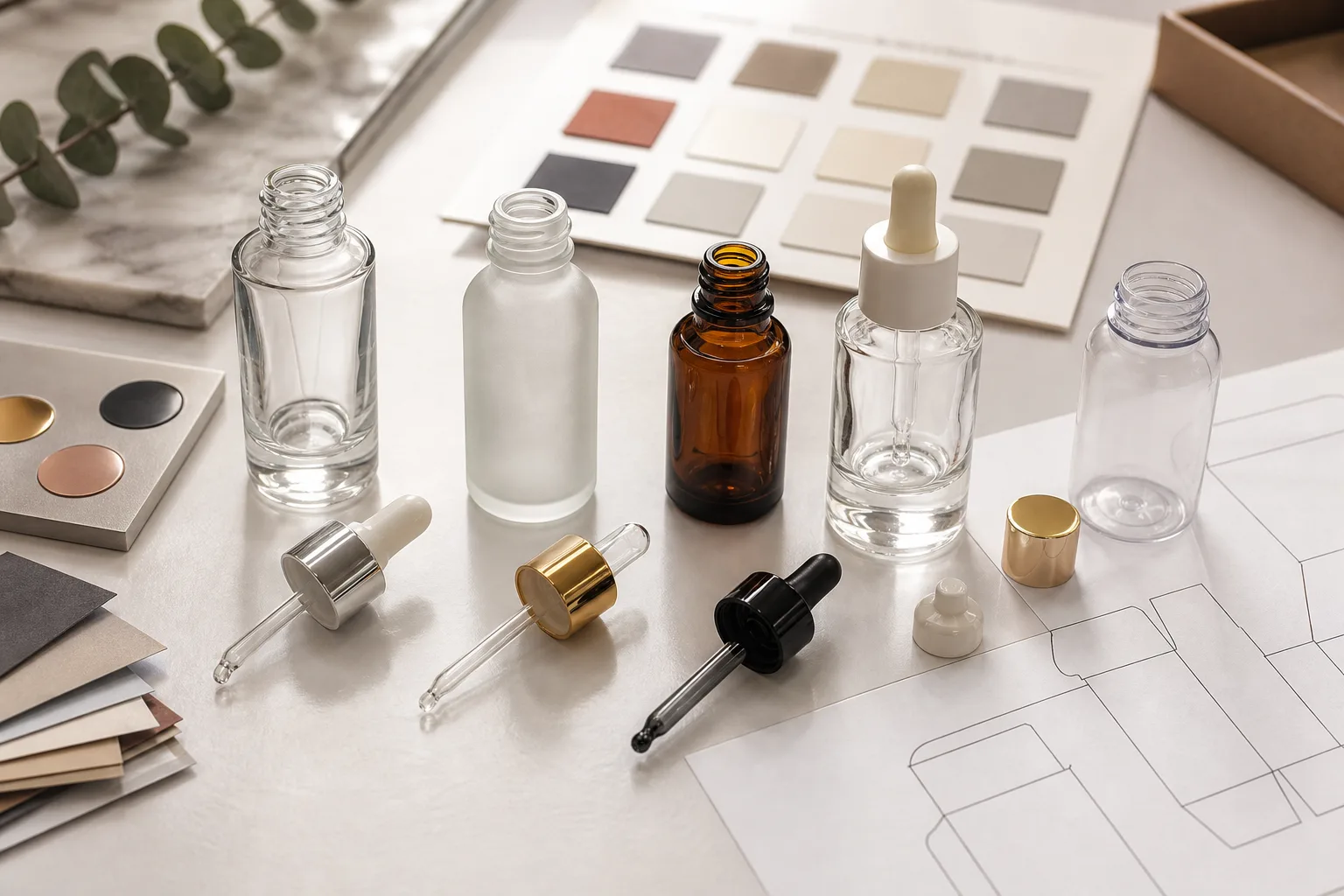
Dropper packaging should be reviewed as a complete system, not only as a bottle shape.
Quick answer: when dropper bottles make sense
Choose a dropper bottle when the product is a low- to medium-viscosity serum, facial oil, essence, treatment, or fragrance-adjacent cosmetic oil that benefits from small-amount dispensing and a premium bottle presentation. Slow down when the formula is thick, gritty, volatile, sensitive to air or light, strongly fragranced, oil-rich, or expected to make exact dose, medical, recyclable, leak-proof, or compatibility claims.
| Decision | Good signal | Check before moving forward |
| Use a dropper | The product is a serum, facial oil, essence, lightweight treatment, or cosmetic oil. | Test draw, drop behavior, residue, leakage, and user handling with filled samples. |
| Compare glass and plastic | The team is balancing premium feel, weight, breakage, travel use, and recycling-design questions. | Review formula contact, decoration, closure fit, and package-level claim support. |
| Review another dispenser | The formula is thick, foamy, gritty, unstable, or hard to draw into a pipette. | Compare pumps, airless packaging, tubes, jars, or other dispensing routes. |
| Request samples | The bottle size, formula type, material preference, decoration route, and target market are known. | Ask for matched bottle, collar, bulb, pipette, wiper/reducer if relevant, and carton samples. |
For product browsing, compare JPS Packaging dropper packaging options for serums and oils. If you are still deciding whether a dropper is the right route, use the checks below before sending an RFQ.
Scope and source note
This article uses research checked on May 18, 2026. It focuses on cosmetic, skincare, beauty, personal care, and fragrance-adjacent packaging. It does not cover laboratory pipettes, eye-drop medicine, pharmaceutical dosing, cannabis tinctures, finished essential oil retail products, or medical packaging.
That boundary matters because the public search results for dropper bottles mix beauty packaging with labware, medicine, broad wholesale bottle listings, aromatherapy, and cannabis-related pages. JPS Packaging should treat this article as a cosmetic packaging support guide, while the /dropper page remains the main category page for sourcing.
The article also uses cautious language around claims. The FDA's cosmetic labeling claims guidance and cosmetic-vs-drug guidance are useful reminders that cosmetic and therapeutic claims must be handled carefully. APR's Design Guide overview and PET rigid guidance show that plastic-package recyclability depends on the full package system, not only the resin. GPI gives material-level glass information, while ISTA test procedures and ASTM D4169 provide shipment-test context. None of those sources proves that a specific JPS dropper package is compatible, leak-proof, recyclable, or certified.
A dropper bottle is a system, not one part
The bottle is only the visible part. A working dropper package depends on several matched components:
| Component | What it does | Buyer check |
| Bottle body | Holds the formula and creates the visual presentation. | Material, capacity, color, coating, shoulder shape, label or print area, and carton fit. |
| Neck finish | Connects the bottle to the collar, cap, or dropper assembly. | Thread style, closure match, tolerance, gasket compression, and sample fit. |
| Collar or cap | Secures the bulb and pipette to the bottle. | Torque, closure feel, finish match, decoration, and leakage risk around the neck. |
| Bulb | Creates suction for drawing product into the pipette. | Material, feel, color, compatibility, odor risk, and contact with formula vapor or residue. |
| Pipette or stem | Draws and dispenses product. | Length, diameter, tip shape, material, bottom clearance, and draw behavior. |
| Wiper or reducer | Helps control excess product around the pipette or opening. | Whether it improves residue control for the formula without making use difficult. |
| Gasket, liner, or seal | Helps the closure system function. | Formula contact, compression, storage orientation, and filled-sample behavior. |
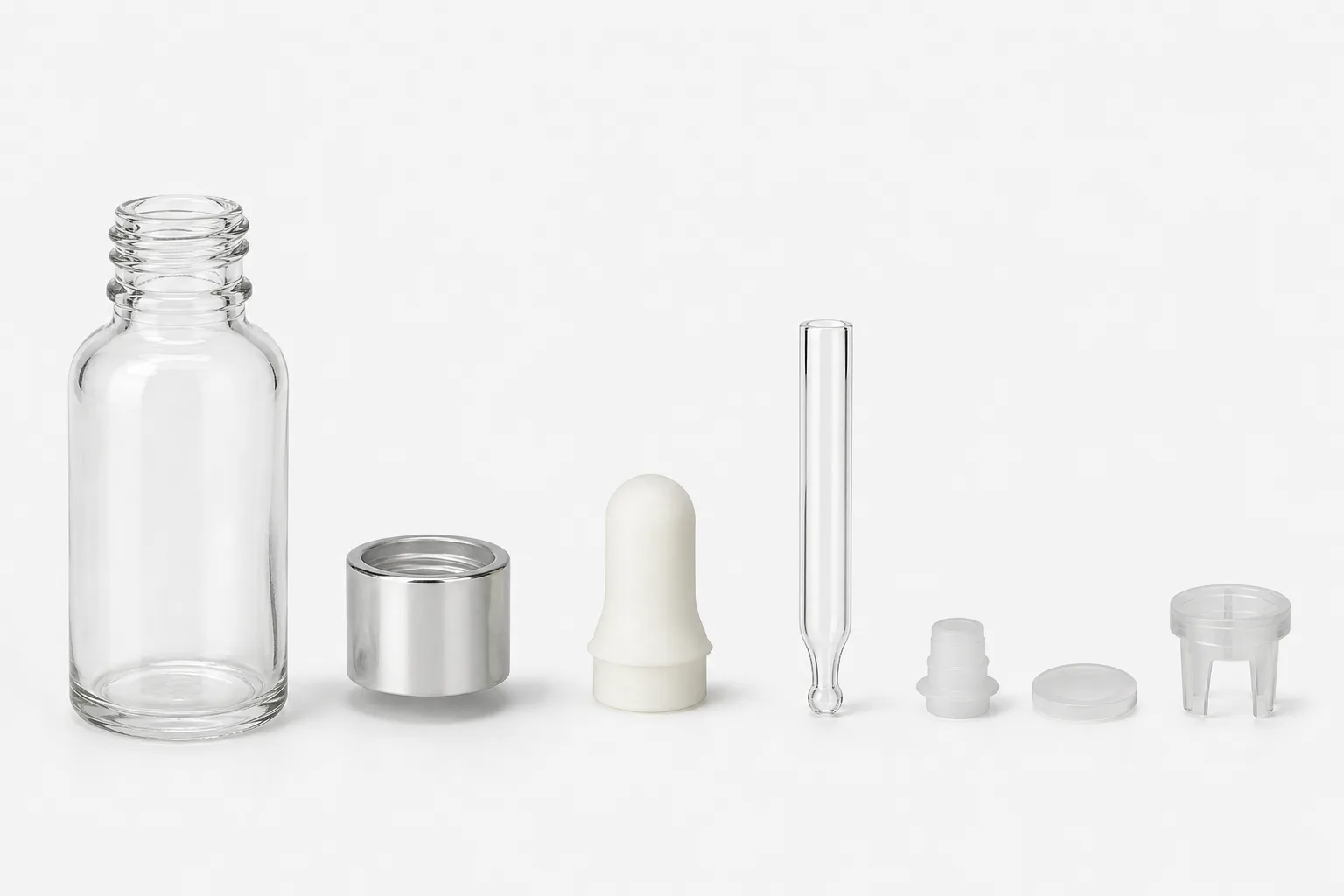
A dropper system includes the bottle, neck finish, collar, pipette, bulb, and formula-contact parts.
This is why a dry sample is only the first step. It can show size, appearance, finish, and basic fit. It cannot prove how the final formula draws, drips, leaks, stains, evaporates, oxidizes, or interacts with the bulb, pipette, gasket, decoration, or carton.
Match the formula before choosing the finish
Dropper bottles are often chosen because they look right for serums and oils. Packaging teams still need to begin with the formula.
Ask these questions before comparing colors or decoration:
Is the formula watery, oily, gel-like, alcohol-based, fragrance-heavy, active-heavy, or unusually viscous?
Does it need amber glass, opaque packaging, an airless route, or another protection strategy?
Can it draw cleanly into a pipette without stringing, clogging, or leaving heavy residue on the neck?
Does the formula contact the bulb, gasket, wiper, liner, adhesive, print, or coating during filling, storage, or use?
Will the product be shipped upright only, on its side, through e-commerce handling, or in a gift set?
For very thick serums, masks, lotions, or products that need more protected dispensing, compare pump dispensers for skincare packaging or airless packaging options before locking into a dropper.
Glass vs plastic dropper bottles
Glass and plastic can both appear in cosmetic dropper packaging, but they solve different problems. The better material depends on formula behavior, brand position, sales channel, shipping risk, decoration, and claim support.
| Decision point | Glass dropper bottle | Plastic dropper bottle |
| Brand feel | Premium, weighty, clear, frosted, amber, or tinted presentation. | Lighter and often more practical for travel, kits, or breakage-sensitive channels. |
| Formula visibility | Clear or tinted glass can show color and fill level. | Clear or opaque plastic options depend on resin and project route. |
| Breakage risk | Higher breakage concern; carton and shipper design matter. | Lower breakage concern, though scuffing, denting, or paneling may still matter. |
| Formula contact | Often used for serums and oils, but closure and bulb parts still need review. | Resin, additives, closure parts, and formula contact must be checked. |
| Decoration | Frosting, coating, screen print, hot stamp, labels, color caps, and premium finishes may be possible. | Labels, printing, color, and closure coordination may be possible depending on material and surface. |
| Recycling claim | Glass has strong material-level recycling language, but decoration and components still matter. | Plastic recyclability depends on resin, color, closure, dispenser, labels, inks, adhesives, and local systems. |
Use glass bottles for cosmetic packaging when the bottle body is the main decision. Use plastic bottles for skincare formulas when weight, breakage risk, travel use, or plastic-family comparison is part of the brief.
For broader material context, the JPS guides to glass packaging material for cosmetic brands and sustainable packaging materials can support the decision. Keep the dropper article focused on the package system, not a general glass or plastic essay.
Neck finish and closure fit decide whether parts actually work together
Dropper assemblies are not interchangeable just because two components look similar. The bottle neck, thread, collar, gasket, bulb, pipette, and optional wiper have to fit as a matched set.
Packaging teams should confirm:
bottle neck finish and closure format;
collar or cap type;
gasket or liner details;
pipette length and bottom clearance;
pipette diameter and tip style;
bulb material and fit;
torque target or closure-feel requirement;
whether a wiper or reducer changes fit or user experience;
filled-sample behavior after storage and shipping.
For broader component comparison, use the JPS closures and dispensers range. The most important rule is simple: do not approve the bottle body before the final dropper assembly has been checked on the actual sample bottle.
Controlled dispensing is not exact dosing
Dropper bottles are useful because they help users dispense small amounts. That is different from saying they deliver an exact dose.
Actual draw and drop volume can change with:
bulb size and recovery;
pipette diameter and tip shape;
formula viscosity and surface tension;
how hard the user squeezes;
whether a wiper or reducer is used;
bottle fill level;
storage temperature;
residue around the neck or pipette.
Use controlled dispensing, small-amount dispensing, or drop-by-drop application when the project has not validated exact volume. Avoid medical dosing language such as accurate dose, precise 1 ml, pharmaceutical dosing, or guaranteed dosage unless a specific assembly and formula have been tested and approved for that claim.
This is especially important for formulas that sound treatment-oriented. Packaging copy should avoid drifting into drug, medical, or therapeutic claims. If the formula claim is close to cosmetic/drug boundaries, the brand should review wording with qualified regulatory support.
Wipers and reducers can help with residue, but they are not magic
Some dropper systems use a wiper, reducer, or insert in the bottle neck. The goal is usually to remove excess product from the pipette, improve user handling, or reduce residue around threads. That can matter for thicker serums, oils, or formulas that leave visible product on the pipette.
Consider a wiper or reducer when:
the pipette comes out coated with too much product;
product collects on the neck or threads;
the formula drips down the outside of the bottle;
the closure gets messy after repeated use;
the team wants a cleaner user experience.
Still, a wiper does not guarantee no leakage, no residue, or no back-off. It changes the way the whole system behaves. Test it with the final formula, the actual pipette, the intended fill level, and the storage orientation the package may face.
Leakage and air-exposure questions need sample testing
Many buyers ask whether dropper bottles prevent air exposure or leakage. The safer answer is: the package can be designed to reduce risk, but the result depends on the complete assembly and the filled formula.
Review these checks before bulk approval:
| Check | What to look for |
| Filled upright storage | Product color, odor, swelling, cap fit, residue, and visible formula change. |
| Side or inverted storage | Leakage around neck, cap, collar, gasket, and pipette path. |
| Draw and dispense test | Whether the formula draws, drips, strings, clogs, spits, or leaves heavy residue. |
| Thread cleanliness | Whether wet threads, overfill, or residue affect closure fit. |
| Carton and shipper check | Whether glass breakage, scuffing, cap movement, or leakage appears after handling. |
| Decoration exposure | Whether label, ink, coating, hot stamp, or cap finish is affected by product contact or rubbing. |
ISTA test procedures and ASTM D4169 can help teams think about distribution hazards, but they do not prove that any specific cosmetic dropper bottle will pass shipping. Treat them as frameworks for planning, not as claims to put in buyer-facing copy.

Use filled samples to check draw, dispensing, leakage, decoration, and packout before bulk approval.
Decoration and custom finish planning
Dropper bottles often carry premium visual expectations. Clear glass, amber glass, frosted finishes, color coatings, gradient effects, screen printing, hot stamping, labels, cap color, bulb color, and carton design can all change the final package.
The decoration route should come after the bottle and dropper system are chosen. A beautiful finish will not fix a poor neck match, formula residue, pipette length issue, or leakage problem.
| Decoration decision | What to define |
| Bottle finish | Clear, frosted, amber, tinted, coated, or custom color direction. |
| Branding method | Label, screen print, hot stamp, coating, cap decoration, carton, or combined route. |
| Artwork status | Logo, label panel, color target, copy space, and proof requirements. |
| Formula exposure | Whether oils, fragrance, alcohol, or product residue may touch labels or printing. |
| Approval sample | Dry proof, decorated proof, filled sample, carton sample, and final sign-off route. |
For deeper decoration decisions, use the JPS guide to packaging decoration and labeling. For project-specific finish review, prepare the bottle format, artwork status, target color, sample deadline, and expected order route before discussing custom cosmetic packaging options.
Sustainability and recycling claims for dropper packaging
Dropper bottles are mixed-component packages. A glass bottle may have a plastic, rubber, silicone, metal, or mixed-material dropper assembly. A plastic bottle may include a closure, pipette, bulb, liner, label, adhesive, ink, coating, or other attachment that affects recyclability.
Use cautious claim language:
| Claim idea | Safer check |
recyclable glass dropper bottle | Confirm whether the exact bottle and dropper assembly can make the claim in the target market. |
plastic dropper bottle is recyclable | Review resin, color, closure, dispenser, label, adhesive, ink, attachments, and local recovery. |
eco-friendly dropper packaging | Replace broad wording with a specific, supported claim. |
refillable dropper bottle | Confirm the refill product, refill process, consumer instructions, and durability plan. |
sustainable serum packaging | Define whether the claim is about material, weight, refill route, recycled content, recyclability, or reduced components. |
APR guidance is useful for understanding plastic package design for recyclability, and GPI provides material-level glass information. They do not prove that every decorated cosmetic dropper package is recyclable or sustainable. The final claim should match the actual package and the supporting documents.
When a dropper is not the best route
A dropper is not the right answer for every serum or oil-adjacent formula. Consider another route when:
the product is too thick to draw and dispense cleanly;
the formula leaves heavy residue on the pipette or neck;
exact dosage is a central claim;
the formula needs stronger airless-style protection;
the product is intended for in-shower use, travel-heavy use, or high-breakage channels;
leakage risk cannot be reduced through the selected bottle, closure, and carton system;
the brand wants sustainability claims that the mixed package cannot support.
In those cases, compare airless packaging options, pump dispensers for skincare packaging, or other cosmetic packaging products before approving a dropper sample.
RFQ checklist for cosmetic dropper bottles
Use this checklist before requesting samples or pricing:
| RFQ item | What to include |
| Product type | Serum, facial oil, essence, treatment, cosmetic oil, fragrance-adjacent oil, or another formula category. |
| Formula notes | Viscosity, oil level, fragrance, alcohol, actives, color sensitivity, light sensitivity, and compatibility concerns. |
| Fill volume | Target fill, bottle size, SKU count, and whether fill level visibility matters. |
| Bottle material | Glass, amber glass, frosted glass, clear plastic, opaque plastic, or undecided. |
| Dropper assembly | Bulb, collar, pipette, tip, gasket, wiper/reducer, neck finish, and desired cap style if known. |
| Decoration | Label, screen print, hot stamp, coating, color, cap/bulb color, carton, and artwork status. |
| Sample checks | Dry sample, decorated proof, filled sample, leakage review, draw/dispense behavior, and carton/shipper check. |
| Claims | Recyclability, refillable, recycled content, sustainability, formula protection, or dosage wording that needs review. |
| Commercial planning | Target order quantity, sample deadline, launch timing, and destination market. |
When you have those details, share formula and sample requirements with the JPS Packaging team through project review and packaging inquiry. If the product still needs decoration or finish planning, include artwork status and sample timing so the team can compare routes before bulk approval.
FAQ
What is a dropper bottle used for in cosmetics?
In cosmetics, dropper bottles are commonly reviewed for serums, facial oils, essences, lightweight treatments, and fragrance-adjacent cosmetic oils. They help users dispense small amounts and create a premium skincare presentation. The final fit depends on formula viscosity, bottle material, neck finish, pipette, bulb, collar, and filled-sample testing.
Are glass or plastic dropper bottles better for serums?
Neither is always better. Glass can support a premium look, amber or frosted options, and strong serum/oil positioning. Plastic may help with weight, travel use, breakage risk, or cost structure. The better route depends on formula contact, decoration, closure fit, shipping, and claim support.
Can a dropper bottle deliver an exact dose?
A dropper can support controlled dispensing, but exact dose should not be assumed. Real draw and drop volume can change with bulb design, pipette size, tip shape, formula viscosity, fill level, temperature, wiper use, and user behavior. Avoid exact dosage claims unless the final package and formula have been tested for that claim.
How do I know whether a dropper fits a bottle?
Check the bottle neck finish, collar or cap, gasket or liner, pipette length, bulb fit, torque, wiper or reducer, and physical sample fit. Do not rely only on nominal size. Matched samples should be tested with the final formula and storage orientation.
Do dropper bottles prevent air exposure or leakage?
They can be designed to reduce risk, but they do not automatically prevent air exposure or leakage. The result depends on closure fit, gasket compression, wet threads, formula viscosity, pipette path, fill level, storage orientation, carton protection, and filled-sample testing.
What should I send when requesting dropper bottle samples or a quote?
Send the formula category, viscosity notes, fill volume, preferred bottle material, neck finish or closure preference, dropper assembly preference, decoration target, claim goals, sample deadline, target quantity, destination market, and launch timing.