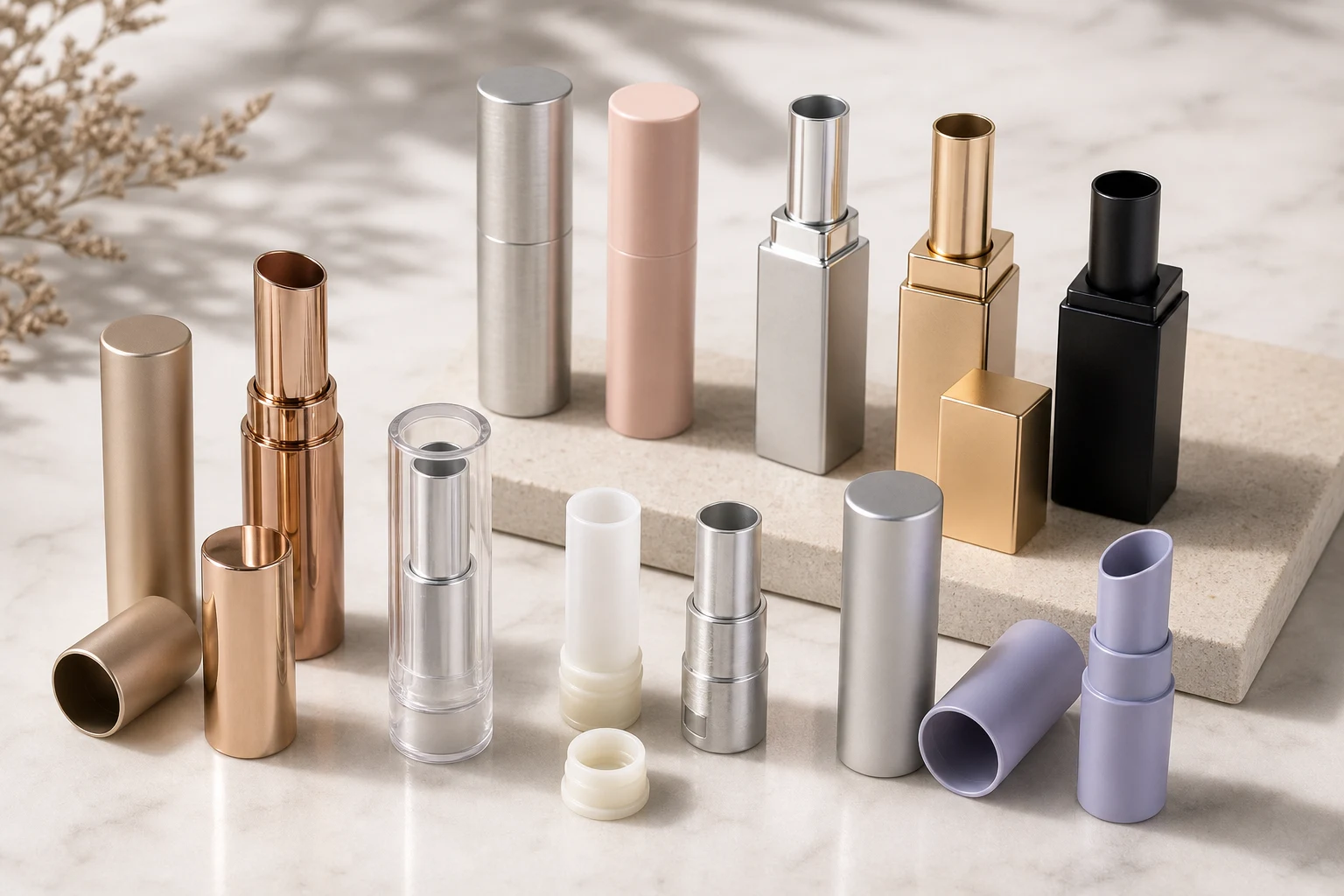
Custom beauty stick packaging should start with the working structure, not the decoration. A balm stick, sunscreen stick, deodorant stick, foundation stick, highlighter stick, or solid skincare stick can share a similar silhouette, but the fill route, cap fit, cup design, and sample checks are not the same.
This page is about solid cosmetic stick containers, not flexible stick-pack sachets. It is written for packaging teams and brand teams comparing a beauty stick packaging supplier, stock molds, refillable routes, PP material options, finish choices, MOQ, and sample approval before opening a tool or placing a bulk order. For broader product browsing, compare JPS Packaging's beauty stick packaging options before narrowing the custom route.
The lowest-risk route is usually an existing mold with controlled customization first: color, finish, label, print, carton, or cap treatment. Move to private tooling only when the stock structure cannot support the formula, shape, fill route, or brand requirement.
For a supplier shortlist, first choose a candidate stick body, then confirm capacity, fill method, material route, sample availability, MOQ by SKU, decoration proof, and RFQ details. That is the decision path this guide supports.

Fast answer: when custom solid stick packaging makes sense
| Project need | Better route | What to confirm first |
| Pilot launch or lower-risk first order | Stock mold with controlled color, label, or simple print | Formula fit, cap retention, MOQ by SKU, and sample timing. |
| Premium shelf look | Matte, soft-touch, metallic, or decorated solid stick container | Rub resistance, finish consistency, and carton protection. |
| Refillable or sustainability-led project | Refillable or simplified PP component route | Pod fit, replacement logic, claim wording, and long-term wear. |
| Distinctive brand shape or mechanism | Private mold or heavily modified structure | Repeat volume, tooling budget, fill route, and approval timeline. |
If the project is still at the selection stage, use the beauty stick packaging guide to compare capacity, formula fit, component checks, and use cases before requesting custom decoration or tooling.
Which JPS page should answer which beauty stick question?
The beauty stick cluster has several related guides. Use this page for custom structure and sample approval. Use the related pages when the question is mainly product browsing, MOQ, cost, production, or sourcing.
| Search or buyer question | Best JPS destination | Why |
| Beauty stick packaging supplier, product options, custom low MOQ options | beauty stick packaging options | Product/category intent needs actual stick formats before a quote. |
| Custom beauty stick packaging, solid stick container customization, finish route | This guide | Customization decisions depend on mold, material, fill route, sample proof, and decoration. |
| Low MOQ beauty stick packaging | low MOQ beauty stick packaging routes | Quantity questions need stock-vs-custom tradeoffs. |
| Beauty stick packaging cost or price | beauty stick packaging cost drivers | Cost depends on tooling, finish, SKU count, sample rounds, and decoration. |
| Beauty stick packaging production or manufacturing process | beauty stick packaging production checks | Production questions need process, QC, and filled-sample approval details. |
Questions this guide answers
How do you customize solid beauty stick packaging without creating avoidable cost?
When is a stock mold enough, and when is a private mold justified?
What should a buyer test before approving a refillable, matte, metallic, or premium stick pack?
Which quote details improve MOQ, sample, and production discussions?
Best-fit applications for solid stick containers
| Use case | Recommended packaging direction | What to check |
| Sunscreen or skincare stick | Round or oval PP stick with secure cap and practical grip | Heat exposure, formula drag, cap retention, and decoration wear. |
| Foundation, contour, or highlighter stick | Slim or mid-size twist-up structure with cleaner retail finish | Twist stability, shade coding, cap cleanliness, and label logic. |
| Balm, deodorant, or lotion bar | Wider stick body with stronger wall support and daily-use cap | Warm-storage leakage, oil staining, base torque, and shipping fit. |
| Premium hero SKU | Decorated stick container or refillable outer case | Finish durability, replacement logic, and repeat-order economics. |
Custom options to confirm with a supplier
A custom request should be specific enough for the packaging supplier to respond with samples, drawing checks, MOQ by SKU, and a realistic approval path. If the brief only says "premium custom stick," the supplier cannot judge fit, filling, or decoration risk.
| Custom option | Supplier check | RFQ input to prepare |
| Custom color or finish | Color tolerance, matte/gloss/metallic consistency, rub resistance, and stain risk. | Pantone direction, artwork status, target finish, and sample deadline. |
| Private label or logo decoration | Print area, curved-surface registration, label fit, hot stamping or screen-print limits. | Logo file, label size, carton need, shade system, and number of SKUs. |
| Refillable or mono-material route | Pod retention, refill instructions, PP component set, colorant choice, and claim wording. | Refill logic, expected reuse path, material claim, destination market, and evidence need. |
| Private mold or modified structure | Tooling scope, dimensional drawing, repeat volume, sample rounds, and approval timeline. | Target shape, fill weight, formula behavior, forecast volume, and launch date. |
Stock mold versus private mold
The usual custom route is not a new tool on day one. A stock mold is often the better first step when the formula already fits a proven cup, cap, and mechanism. That keeps MOQ, sample rounds, and production risk lower while the brand still customizes color, finish, print, or carton.
| Route | Choose it when | Commercial note |
| Stock mold | The formula and fill weight already fit a proven structure. | Best for lower MOQ, faster samples, and early validation. |
| Modified stock route | The project needs custom color, logo, finish, or carton without changing the core mechanism. | Usually raises MOQ less than a private mold route. |
| Private mold | The required shape, refill logic, or formula fit cannot be solved by available tooling. | Needs tooling budget, clearer repeat volume, and longer approval timing. |
Material, filling route, and finish options
A custom stick project is still a component-system decision. Outer shell, inner cup, base, cap, label area, refill part, and carton all affect the final result. Keep the route specific enough that the supplier can confirm how the solid formula will be filled, cooled, twisted, and protected.
| Option | Best fit | Approval note |
| PP stock structure | Balm, sunscreen, deodorant, and many skincare stick launches | Check formula compatibility and cap feel before finish decisions. |
| PCR or mono-material PP direction | Projects with a clearer material story | Approve color tolerance, odor, and claim wording with the full component set. |
| Metallic or aluminum-look finish | Premium skincare or color-cosmetic positioning | Confirm whether the look comes from shell material or decoration. |
| Refillable pod route | Hero SKUs with repeat-purchase potential | Test pod fit, user handling, and long-term outer-case wear. |
| Matte or soft-touch finish | Premium brand direction with stronger hand feel | Rub and stain testing matter more on sunscreen and oil-rich formulas. |
Material claims and testing references
PCR, mono-material, recyclable, and refillable wording should be tied to the exact component set. A solid stick package is not only the outer shell; it can include a cup, cap, base, label, adhesive, refill pod, carton, and decoration. The 16 CFR Part 260 Green Guides listing on GovInfo is a useful starting point for avoiding unsupported environmental marketing claims.
For plastic package design, color and label decisions can affect sortation. APR's Near Infrared (NIR) sorting resource explains why dark colors, high label coverage, and package shape may need testing before a recyclability claim is used. For e-commerce or distribution risk, use ASTM D4169 and ISTA test procedures as planning references; they do not prove a specific stick package is shipment-ready without project-specific testing.
What to confirm before top-fill, bottom-fill, or refillable routes
| Route | What to confirm | Why it matters |
| Top-fill | Cooling behavior, formula shrinkage, and surface finish after filling. | An attractive shell will not save a rough or sunken stick surface. |
| Bottom-fill | Base strength, plug fit, and repeated twist performance. | Daily-use packs often fail at the base or plug before the shell. |
| Refillable | Pod retention, replacement logic, outer-case durability, and consumer instructions. | Refillable claims need a real route, not only a removable part. |
MOQ, samples, and quote details
MOQ is not one number for all custom solid stick packaging. It changes by stock availability, material route, custom color, finish, label or print method, refillable structure, and carton design. Treat the MOQ as SKU-specific until the supplier reviews the actual component path.
| Project route | Typical buyer read | What to ask for |
| Stock structure + label | Fastest entry route for early testing or lower-risk launches. | Ask for a plain sample and a decorated proof. |
| Custom color or simple logo | Usually needs more approvals than plain stock. | Ask how color, print, and carton affect MOQ by SKU. |
| Special finish, PCR, or refillable route | Needs more sample work and often a higher starting quantity. | Ask for material evidence, wear tests, and route-specific lead time. |
For a deeper quantity discussion, compare low MOQ beauty stick packaging routes. If the question is budget rather than quantity, review the beauty stick packaging cost drivers before asking for a formal quote.
Planning ranges without treating them as a promise
Public supplier listings often show MOQ or lead-time numbers, but those numbers only apply to a specific mold, factory schedule, decoration route, and approval process. For JPS Packaging, treat MOQ and lead time as route-specific until the team confirms the exact stick body, finish, SKU count, sample need, and destination market.
| Route | MOQ pressure | Timeline pressure | Best buyer move |
| Stock body with label or simple proof | Usually lowest | Usually fastest | Ask for a plain sample, label area, and decorated proof path. |
| Custom color, finish, or logo method | Medium; SKU and finish dependent | Medium; proof rounds matter | Confirm MOQ by color, finish, and SKU before locking artwork. |
| Refillable, PCR, mono-material, or private mold route | Highest; tooling and evidence dependent | Longest; sample and claim checks matter | Prepare forecast volume, material claim boundary, and sample approval gates. |
Supplier checklist before you request a quote
Product type and use case: sunscreen, balm, deodorant, foundation, contour, highlighter, lotion bar, or another solid format.
Formula details: fill weight, hardness, oil level, fragrance, actives, fill temperature, and cooling behavior.
Packaging target: capacity, shape, cap style, twist route, stock mold or private mold, refillable or not.
Brand finish: Pantone direction, matte or metallic finish, logo method, carton need, and shade or SKU system.
Commercial details: MOQ target, sample deadline, launch date, shipping market, desired RFQ response date, and whether the project needs e-commerce protection.
Related JPS guides and next step
| If you need to... | Use this next |
| Compare stick structures, capacities, and use cases | Browse solid beauty stick packaging options |
| Check the full selection logic before custom work | Read the beauty stick packaging guide |
| Understand sample approval and production sequence | Review beauty stick packaging production checks |
| Prepare a quote request | Send formula, MOQ, finish, and sample timing to the JPS Packaging team |
When the route is clear, send the formula type, fill weight, target capacity, fill route, finish direction, MOQ target, sample deadline, launch date, and destination market to JPS Packaging. That gives the packaging team enough information to check mold fit, decoration feasibility, and sample sequence before quoting.
FAQ
What does custom beauty stick packaging usually mean?
In practice it usually means a solid stick container customized by color, finish, label, logo, carton, refill route, or structure choice to fit a specific formula and brand direction.
How can a brand keep custom solid stick packaging affordable?
Start with an available mold, limit decoration complexity, approve filled samples before adding premium finishes, and delay private tooling until demand and formula fit are clearer.
What should a supplier provide before bulk production?
The useful minimum is a component drawing or size sheet, plain and decorated samples, MOQ breakdown, testing plan, and approval notes for formula fit, cap retention, and finish durability.