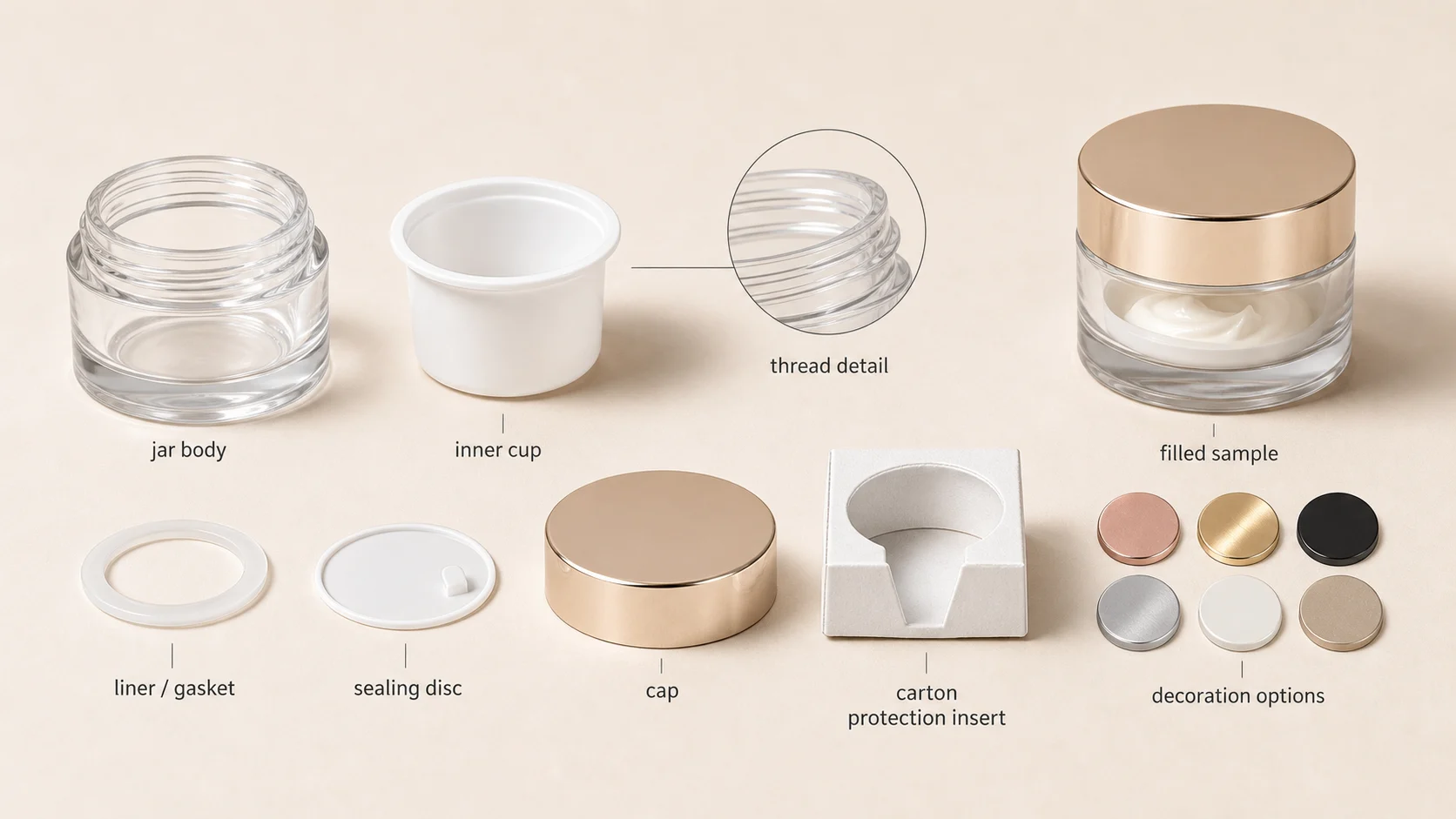
A cosmetic jar is a wide-mouth package used for creams, masks, balms, scrubs, body butter, hair treatment and other formulas that need easy filling and controlled hand or spatula access. For a buyer, the jar is not just the cup. A production-ready jar includes the outer body, inner liner when needed, closure, liner or gasket, thread fit, decoration, carton packing and the approval records that prove the package can survive filling, storage and shipment.
The practical question is not only what is a cosmetic jar. The better question is which jar structure protects the formula, supports the brand position and can be repeated at the required MOQ without quality surprises.
Core Components Buyers Should Specify
| Component | Common Choices | Buying Check |
|---|---|---|
| Jar body | PET, PP, acrylic, glass, aluminum outer shell, PCR-ready plastic | Confirm capacity, brimful volume, fill volume, weight, wall thickness and formula contact surface. |
| Closure | Screw cap, double-wall cap, aluminum cap, wood-look cap, refill cap | Check thread match, torque range, repeated opening and cap scuffing after carton packing. |
| Liner or gasket | PE liner, foam liner, pull tab seal, inner disc, spatula holder | Test leakage, oil staining, fragrance contact and consumer removal experience. |
| Decoration | Silk screen, hot stamping, label, spray coating, metallization, soft touch | Review color tolerance, rub resistance, scratch resistance and label adhesion after aging. |
Material Routes and Typical Uses
Plastic cosmetic jars are useful for lightweight skincare, travel sizes and cost-controlled programs. PP is often selected for cream jars that need good chemical resistance. PET gives clear shelf presentation for masks, gels and scrubs. Acrylic supports a premium thick-wall look, but buyers should confirm impact risk, decoration cost and compatibility with essential oils or aggressive formulas.
Glass cosmetic jars are chosen when the brand needs weight, clarity and a premium feel. They work well for high-value creams, balms and spa masks, but the quote must include protective carton design, inner dividers and drop or vibration checks. Aluminum or aluminum-shelled jars can support a metallic finish and refillable positioning, but cap fit and liner selection become especially important.
Specification Example for an RFQ
- Capacity: 30 g and 50 g cream jar, brimful volume confirmed by supplier drawing.
- Material: PP inner liner with ABS or PP outer cap, or glass body with PP liner.
- Closure: screw cap with PE liner, target torque range confirmed on filled samples.
- Finish: matte white body, one-color logo, optional hot stamping on cap.
- Order route: stock mold sample first, decorated sample second, pre-production sample before bulk.
- Packing: each jar in polybag or paper sleeve, export carton with dividers if glass is selected.
MOQ, Lead Time and Quote Breakdown
For stock cosmetic jar molds, buyers commonly plan around 5,000 to 10,000 pieces per size for simple decoration, while custom color, sprayed finish or private mold work can raise the MOQ. Sample lead time is often 5 to 10 working days for stock samples and 10 to 20 working days for decorated samples. Bulk lead time is usually quoted after artwork, sample and deposit approval.
| Quote Line | Why It Matters |
|---|---|
| Unit jar price | Should state whether body, cap, liner and inner disc are included. |
| Decoration charge | Separates screen setup, hot stamping plate, label printing or spray coating cost. |
| Sample cost | Clarifies whether the sample is stock, decorated or formula-tested. |
| Packing cost | Important for glass jars, heavy caps and export cartons. |
| Freight assumptions | Prevents a low unit price from hiding high landed cost. |
Testing Protocol Before Approval
For packaging validation, buyers can align carton transit checks with ISTA test procedures or ASTM D4169 style distribution testing. Production, filling, storage and shipment controls can also be reviewed against ISO 22716 cosmetic GMP expectations when the buyer needs a stricter audit trail.
A jar sample should be filled with the real formula before approval. Check 24-hour inverted leakage, cap torque, thread wear after repeated opening, liner staining, formula discoloration, label rub, hot stamping adhesion, carton drop and vibration. For export orders, buyers can ask whether the supplier can prepare internal inspection records, AQL inspection photos and carton specifications. When formal transport validation is required, the buyer can align the carton plan with ISTA-style drop and vibration testing through a qualified lab.
Supplier Evidence to Request
- Component drawing with capacity, diameter, height and neck finish.
- Material declaration for formula-contact parts.
- Decorated sample photos under normal light and close-up inspection.
- Past production reference for similar jar material and finish.
- QC checklist showing appearance, assembly, leakage and packing checks.
Material and Use-Case Evidence
A cosmetic jar is defined by more than volume. Material, wall structure, shoulder shape, closure and liner decide whether it fits cream, balm, mask or scrub. Buyers should ask for sample jars filled with the real formula before approving weight, finish or decoration.
| Jar route | Best-fit use case | Evidence to request |
|---|---|---|
| Glass jar | Premium cream, balm and spa mask | Drop handling, carton protection and closure torque. |
| PP jar | Lightweight cream, scrub or refill concept | Formula contact, color tolerance and label adhesion. |
| PETG or acrylic-look jar | Clear shelf presentation with lighter weight | Stress cracking, cap fit and rub resistance. |
| Double-wall jar | Premium hand feel with plastic weight control | Wall fit, insert stability and decoration proof. |
Approval File for Cosmetic Jar Definition
A stronger procurement file for cosmetic jars should make the sample approval path repeatable. Before a purchase order, the internal file should identify the component version, formula used for testing, decoration proof, packing method and the approval date. This protects repeat orders because the supplier and brand are comparing against the same reference sample instead of a photo or loose description.
| Spec to lock | Detail to record | Why it matters later |
|---|---|---|
| Use case | Cream, balm, mask, scrub or refill jar | Defines mouth width, wall and cap choice |
| Material route | Glass, PP, PETG or double-wall plastic | Controls weight, clarity and formula risk |
| Closure route | Screw cap, liner, sealing disc or spatula | Controls protection and user handling |
| Packing route | Inner tray, carton and orientation | Protects heavy or decorated jars in transit |
The most common failures happen when a project moves from a nice-looking sample to production without documenting the exact acceptance point. The checklist below should be reviewed before deposit, not after goods are already packed.
| Failure point | How it appears | Control before order |
|---|---|---|
| Generic jar choice | Material selected only by appearance | Match material to formula and market position |
| Seal weakness | Liner not compressed correctly | Approve filled sample and torque |
| Decoration mismatch | Artwork does not fit curved or wide cap surface | Review decorated proof |
| Transit scuffing | Jar or lid scratches in carton | Confirm carton divider or tray |
MOQ and Lead Time Planning Range
For What Is a Cosmetic Jar? Materials, Closures and Buying Checks, JPS can use the following early quotation ranges for cosmetic jar packaging. The final quantity for What Is a Cosmetic Jar? Materials, Closures and Buying Checks should be confirmed after checking mold availability, finish route, component stock, artwork status and SKU count.
| Route | Planning range | When it makes sense |
| Stock glass, PP or PET jar | 1,000-3,000 pcs | Useful for cream, balm, mask, scrub or trial-size skincare projects. |
| Custom lid, liner, color or decoration | 3,000-10,000 pcs | Best when the jar is existing but the shelf presentation needs branding. |
| Private mold, double-wall or premium custom jar | 20,000-30,000+ pcs | Needed when the jar shape, wall thickness or closure system is unique. |
| Step | Typical planning time |
| Stock dry samples | 3-7 working days |
| Decoration or liner proof | 10-20 working days |
| Bulk production after approval | 25-45 working days |
| Private mold route | 60-90+ working days |
Sample Approval Criteria Before Bulk Production
For What Is a Cosmetic Jar? Materials, Closures and Buying Checks, a good-looking dry sample is only the first check. The buyer should approve the filled pack, component fit, decoration proof and packing method before releasing cosmetic jar packaging for bulk production.
| Check | Pass signal |
| Seal and liner fit | Approve cap, thread, liner, gasket and inner disc with the filled formula. |
| Formula contact | Check staining, odor transfer, stress cracking and oil migration before deposit. |
| Decoration durability | Review label, hot stamp, coating, cap finish and packed-sample scuffing. |
| User handling | Check opening feel, spatula fit, inner lid removal and carton presentation. |
Common Failure Points to Catch Early
| Failure point | What it looks like |
| Liner leak | Formula reaches the cap or carton after storage. |
| Cross-threading | The cap feels acceptable once but catches during repeated opening. |
| Material mismatch | Cream, balm or scrub stresses plastic, coating or liner. |
| Cost hidden in components | Jar body, lid, liner, decoration and carton are quoted separately. |
Specification Details
Before comparing unit price, the purchase order should identify the parts that affect function, decoration and shipment. That makes supplier quotes easier to compare because every quote is tied to the same component set.
| Specification item | What to define | Why it matters |
| Formula and fill weight | cream, balm, mask, scrub or body butter; 5 ml to 150 ml range | Confirms jar material, liner and cap requirements. |
| Jar system | outer jar, inner liner, thread, liner, gasket, cap and spatula if used | Prevents treating the jar body as the only approved part. |
| Decoration | lid finish, label, hot stamp, coating or carton | Controls shelf look and rub resistance. |
| Packing | inner disc, carton insert, master carton and shipment route | Protects seal, cap and surface finish. |
Quote Review Points
| Quote line | What to check | Reason to check it |
| Quantity route | Confirm whether What Is a Cosmetic Jar? Materials, Closures and Buying Checks uses stock parts, decorated parts or tooling parts. | Each route changes MOQ, unit cost and approval time. |
| Included components | Check whether the quote includes every cosmetic jar packaging part, matched closure, insert, carton and decoration proof. | A low unit price for What Is a Cosmetic Jar? Materials, Closures and Buying Checks is not useful if key parts are quoted later. |
| Sample revisions | Ask how many What Is a Cosmetic Jar? Materials, Closures and Buying Checks sample revisions are included before extra proof charges apply. | Sample changes for What Is a Cosmetic Jar? Materials, Closures and Buying Checks often decide whether the launch calendar stays realistic. |
| Packing and shipment | Confirm carton count, inner packing and shipping assumptions for What Is a Cosmetic Jar? Materials, Closures and Buying Checks. | Packing method changes landed cost and visible defect risk. |
When to Change Route
Not every brief should stay on the first quoted route. For What Is a Cosmetic Jar? Materials, Closures and Buying Checks, the buyer should change route when the formula, finish, MOQ or calendar no longer fits the selected component family. This avoids forcing a stock component to behave like a custom mold for What Is a Cosmetic Jar? Materials, Closures and Buying Checks, or paying for tooling before the product-market test is clear.
| Signal | Better route | Reason |
| Several shade or SKU tests are still uncertain | Start with available stock components and simple decoration | Keeps What Is a Cosmetic Jar? Materials, Closures and Buying Checks flexible while the brand tests demand. |
| The formula fails filled-sample checks | Change material, closure, liner, wiper, mechanism or coating before artwork approval | Fixing function after artwork approval delays What Is a Cosmetic Jar? Materials, Closures and Buying Checks and creates avoidable cost. |
| The pack shape is central to brand identity | Move to private mold only after forecast, tooling budget and pilot sample approval are clear | Custom tooling for What Is a Cosmetic Jar? Materials, Closures and Buying Checks should be tied to repeat-order expectations. |
For a faster review of What Is a Cosmetic Jar? Materials, Closures and Buying Checks, separate must-have requirements from optional finish ideas. Must-have items for What Is a Cosmetic Jar? Materials, Closures and Buying Checks should cover formula compatibility, component fit, MOQ, lead time and shipment protection; optional finish ideas can wait until the first sample route is technically workable.
Approval Record
Keep a short approval record
| Record item | Keep in the file | Decision value |
| Approved component sample | cosmetic jar packaging sample for What Is a Cosmetic Jar? Materials, Closures and Buying Checks, labeled with version, date and supplier reference | Prevents similar samples being mixed after revisions. |
| Filled sample notes | Formula, fill weight, storage condition and pass/fail observations for What Is a Cosmetic Jar? Materials, Closures and Buying Checks | Shows why the selected pack works for the real product. |
| Decoration proof | Color standard, artwork proof, print position and rub check notes for What Is a Cosmetic Jar? Materials, Closures and Buying Checks | Reduces disputes between proof and bulk production. |
| Packing sample | Inner packing, carton count, carton mark and shipment assumption for What Is a Cosmetic Jar? Materials, Closures and Buying Checks | Connects appearance approval with delivery risk. |
Reference Standards Buyers Can Use
For What Is a Cosmetic Jar? Materials, Closures and Buying Checks, transport and carton approval can reference ASTM D4169 or ISTA test procedures when the shipping route needs a formal distribution test. For filling and handling controls related to What Is a Cosmetic Jar? Materials, Closures and Buying Checks, ISO 22716 gives the buyer a GMP reference point. These references do not replace the buyer's own What Is a Cosmetic Jar? Materials, Closures and Buying Checks specification; they give the purchasing team clearer language for supplier approval.
Example RFQ Brief
The example below shows how a cosmetic jar packaging request becomes quotation-ready. It is a planning scenario for What Is a Cosmetic Jar? Materials, Closures and Buying Checks, not a guarantee for every material, finish or market.
| Brief item | Example detail |
| Product | 50 ml cream jar, balm jar or mask jar |
| Recommended route | Stock jar body with approved liner and branded lid or label |
| Planning quantity | 1,000-3,000 pcs for stock route; 3,000-10,000 pcs for custom decoration |
| Approval samples | Jar body, cap, liner, filled sample, decoration proof and carton insert |
Send formula type, fill weight, preferred material, cap or liner requirement, finish reference, MOQ and carton plan so JPS can check the jar as a complete system.
Quote Brief
For cosmetic jar sampling, send the project brief with formula, fill weight, material preference, seal requirement and finish target.